Most manufacturing software comparisons make one mistake right out of the gate. They rank everything on a single scale, as if a 12-person job shop and a global automotive supplier need the same system.
They don't.
Here's the thing: a job shop needs fast quoting and dead-simple job costing. An automotive supplier needs finite scheduling, IATF 16949 quality tracking, and traceability that can survive an audit. A food manufacturer needs recipe management and shelf-life tracking. Give any of them the wrong system and you'll spend 2026 fighting your own software instead of running your floor.
So instead of one ranking, this guide breaks 37 platforms down by what they actually do. MRP. Shop-floor execution. Quality. Maintenance. Costing. AI. Pricing. Who it fits and who it doesn't.
One thing up front: pricing for most manufacturing ERPs and MES platforms is quote-based, not published. Where a vendor hasn't made pricing public, I've said so instead of guessing. Same goes for features, AI capabilities, and certifications. If it's not verified, it's marked "not publicly disclosed."
Let's dive right in.
Quick comparison table
| Rank | Manufacturing Software | Best For | Starting Price | Manufacturing Type | Key Strength |
|---|---|---|---|---|---|
| 1 | TwoWorks ERP | Manufacturers wanting one connected system, not five bolted-together tools | Not publicly disclosed | Discrete, Process | Integrated MRP, production, and finance in one platform |
| 2 | SAP S/4HANA Cloud | Global enterprise manufacturers | Not publicly disclosed | Discrete, Process, Mixed | Global supply chain and financial consolidation |
| 3 | Oracle Fusion Cloud ERP | Large global enterprises | Not publicly disclosed | Discrete, Process, Mixed | AI-driven supply chain planning |
| 4 | Microsoft Dynamics 365 SCM | Enterprises already on Microsoft | Not publicly disclosed | Discrete, Process, Lean | Copilot AI built into planning and scheduling |
| 5 | IFS Cloud | Asset-heavy and service-driven manufacturers | Not publicly disclosed | Discrete, Process, Project | Asset management fused with production |
| 6 | Plex Smart Manufacturing | Mid-market to enterprise discrete manufacturers | ~$3,000/month | Discrete, Automotive | Native MES and quality built in from day one |
| 7 | Infor CloudSuite Industrial | Complex discrete and mixed-mode manufacturers | Not publicly disclosed | Discrete, Mixed-mode | Advanced scheduling with industry templates |
| 8 | Epicor Kinetic | Mid-market discrete manufacturers, job shops | Not publicly disclosed | Discrete, Make-to-Order | Job costing and real-time shop-floor data |
| 9 | Acumatica Manufacturing Edition | Growing mid-market manufacturers | $6,396/year | Discrete, Batch, Repetitive | Unlimited users, no per-seat penalty |
| 10 | Oracle NetSuite | Growing mid-sized manufacturers | Not publicly disclosed | Discrete, Light Assembly | Unified financials and inventory |
| 11 | Odoo | Budget-conscious mid-market | $31.10/user/month | Discrete, Custom | Modular flexibility across 50+ apps |
| 12 | ERPNext | SMEs wanting open-source | $0 self-hosted / $300/mo managed | Discrete, Job-work | Zero per-user licensing fees |
| 13 | Siemens Opcenter | Regulated enterprise MES | Not publicly disclosed | Discrete, Process | Digital twin and ISA-95 depth |
| 14 | SYSPRO | Mid-market discrete and process manufacturers | Not publicly disclosed | Discrete, Process | Lot traceability built for manufacturers only |
| 15 | QAD Adaptive ERP | Automotive and life sciences | Not publicly disclosed | Discrete, Process, Repetitive | Supplier portals and rapid rollout |
| 16 | DELMIAWorks (IQMS) | Plastics and repetitive manufacturers | Not publicly disclosed | Repetitive, Process | Real-time machine monitoring, one database |
| 17 | Katana Cloud Inventory | Micro to SMB product brands | $299/month | Discrete, Make-to-Stock | Visual, omnichannel production planning |
| 18 | MRPeasy | Small discrete manufacturers | $49/user/month | Discrete, Make-to-Order | Fast, affordable MRP with no consultant needed |
| 19 | SAP Business One | Small to mid-sized subsidiaries | Not publicly disclosed | Discrete, Process | Global standardization on the SAP brand |
| 20 | Microsoft Dynamics 365 Business Central | SMBs outgrowing accounting software | Not publicly disclosed | Discrete | Financials and light assembly, unified |
| 21 | Sage X3 | Mid-market process and discrete manufacturers | Not publicly disclosed | Process, Discrete, Mixed | Multi-country batch traceability |
| 22 | Global Shop Solutions | Mid-market job shops | Not publicly disclosed | Discrete, Engineer-to-Order | Real-time shop-floor data collection |
| 23 | JobBOSS² | Small custom job shops | Not publicly disclosed | Discrete, Make-to-Order | Fast quoting and flexible scheduling |
| 24 | E2 Shop System | Small machine shops | Not publicly disclosed | Discrete, Make-to-Order | Quick estimating and labor tracking |
| 25 | ProShop ERP | Precision machine shops and CNC | Not publicly disclosed | Discrete, Engineer-to-Order | Paperless floor with AS9100 quality built in |
| 26 | Cetec ERP | SMBs wanting low-cost, web-based ERP | Not publicly disclosed | Discrete, Mixed-mode | Strong native quality system at an SMB price |
| 27 | Rootstock Cloud ERP | Manufacturers already on Salesforce | Not publicly disclosed | Discrete, Mixed-mode | Manufacturing built natively on Salesforce |
| 28 | Priority ERP | Fast-growing mid-market manufacturers | Not publicly disclosed | Discrete, Process | Open APIs and quick implementation |
| 29 | Aptean | Food, beverage, and process manufacturers | Not publicly disclosed | Process, Batch | Recipe management and compliance |
| 30 | Fulcrum | Small discrete manufacturers | Not publicly disclosed | Discrete, Job Shop | Live, dynamic production scheduling |
| 31 | Tulip Interfaces | Frontline shop-floor operations | Not publicly disclosed | Discrete, Process | No-code apps for operators |
| 32 | AVEVA MES | Enterprise process manufacturers | Not publicly disclosed | Process, Batch | High-speed data capture for batch execution |
| 33 | Rockwell FactoryTalk | Enterprise discrete automation | Not publicly disclosed | Discrete, Process | Deep PLC and Allen-Bradley integration |
| 34 | Dassault Systèmes DELMIA | Global complex engineering and assembly | Not publicly disclosed | Discrete, Complex | 3D digital twin simulation |
| 35 | Fishbowl Manufacturing | QuickBooks users needing MRP | Not publicly disclosed | Discrete, Assembly | Deep QuickBooks integration |
| 36 | PM Track ERP | Indian MSME manufacturers | Not publicly disclosed | Discrete, Process | Built-in GST and e-invoicing |
| 37 | Ramco ERP | Global asset-heavy enterprises | Not publicly disclosed | Discrete, Process | Global payroll tied to asset management |
Now let's get into what each one actually does.
ERP vs. MRP vs. MES: what's the difference?
You'll see all three terms in this list, so here's the short version.
ERP (Enterprise Resource Planning) runs the whole business. Finance, sales, purchasing, inventory, and often manufacturing, all in one system.
MRP (Material Requirements Planning) is narrower. It plans what materials you need, when you need them, and what to order to avoid running short. Most manufacturing ERPs include MRP as a module. Some smaller tools are MRP-first and skip full financials.
MES (Manufacturing Execution System) lives on the shop floor. It tracks what's actually happening at the machine level: work orders in progress, downtime, scrap, labor, and quality checks, in real time.
None of these replace each other. A lot of manufacturers run an ERP for the business side and a dedicated MES for the floor, connected together. Keep that distinction in mind as you read through the list. Not every "manufacturing software" here is doing the same job.
1. TwoWorks ERP
Best for: Manufacturers that want sales, purchasing, inventory, production, MRP, finance, quality, and maintenance running off one connected system instead of stitching together five separate tools.
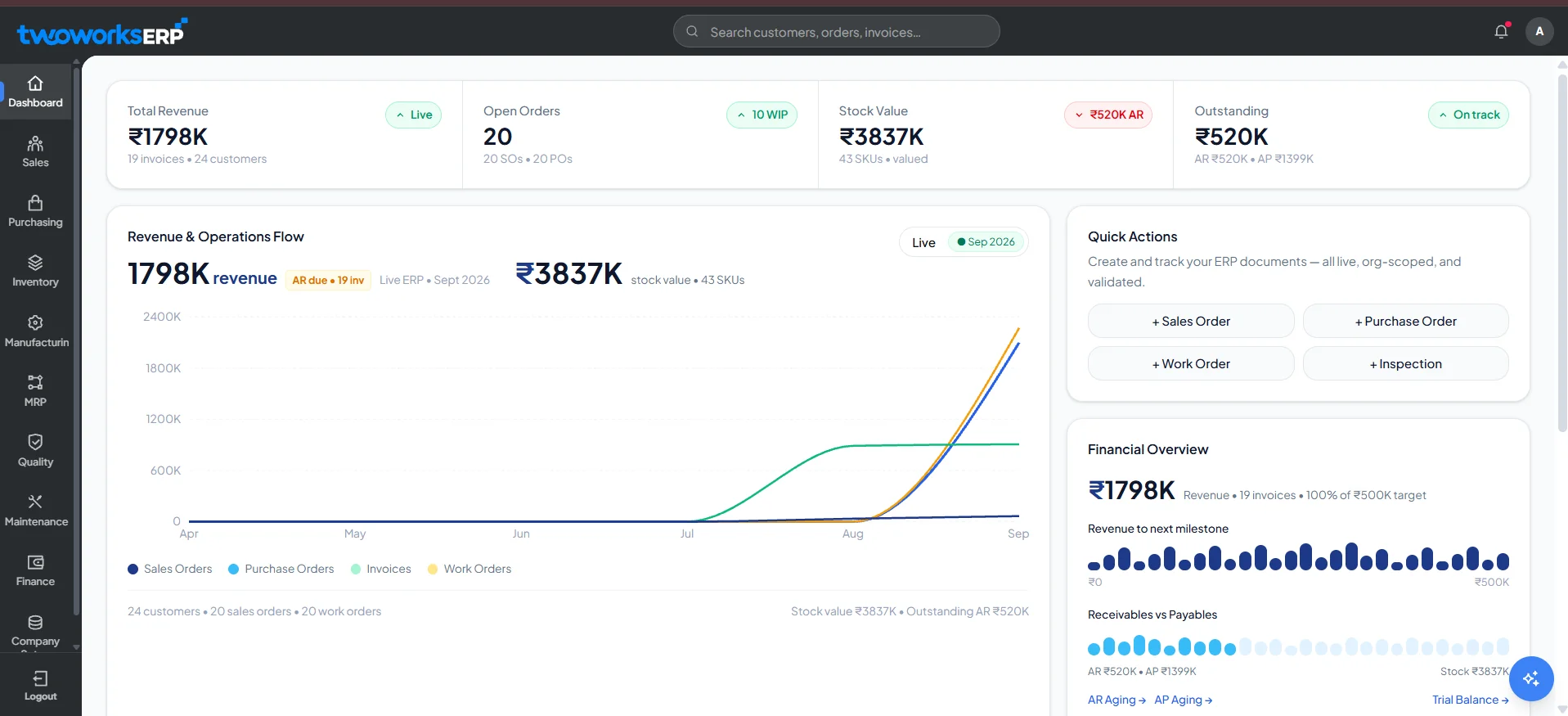
TwoWorks ERP is built around a simple idea: the shop floor and the management team should be looking at the same numbers, in real time, without someone manually reconciling spreadsheets between them.
The platform ships with 9+ integrated modules: Sales & POS, Purchasing, Inventory & Warehouse, Manufacturing, MRP, Quality Management, Maintenance, Finance & Accounting, and Company Management. It's positioned across 12+ industry verticals, with manufacturing as a named focus alongside retail, construction, distribution, food and beverage, healthcare, textiles, and services.
A quick note on transparency. TwoWorks doesn't publish pricing, a detailed AI feature list, or a full integrations catalog on its site. So instead of filling those gaps with guesses, I've marked them "not publicly disclosed." That's the only honest way to review software that doesn't put everything on its pricing page.
What the manufacturing side actually covers
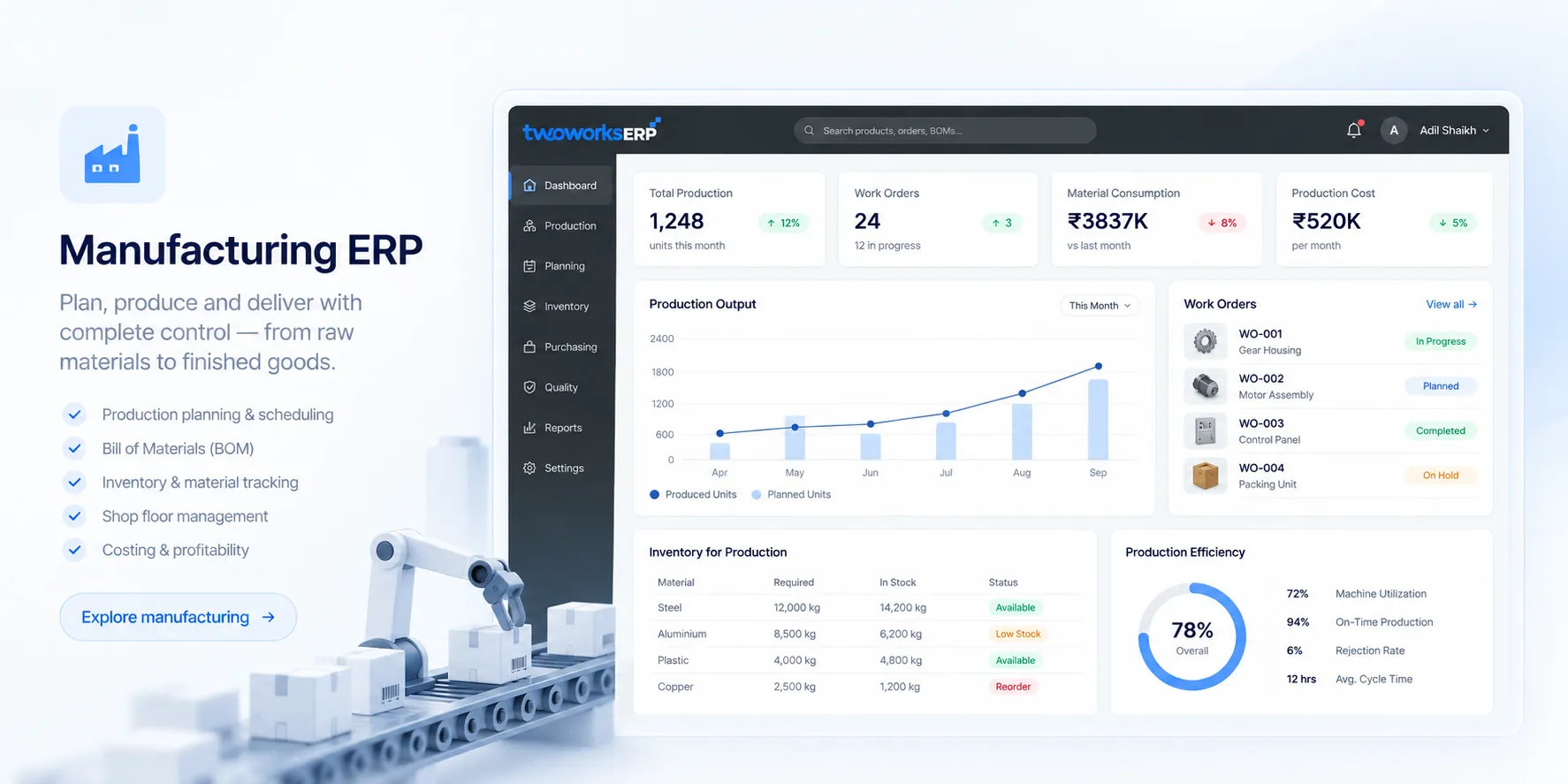
The Manufacturing module handles production orders, Bills of Materials, work-in-progress tracking, shop-floor operations, and production planning, positioned for both discrete and process manufacturing.
MRP plans material requirements, schedules production around what's available, and can generate purchase orders automatically based on actual need. That's planned buying instead of reactive buying, which matters the moment a supplier lead time slips.
Quality Management covers checkpoints, inspections, non-conformance tracking, and traceability that follows a batch from production through delivery.
Maintenance handles preventive maintenance scheduling, equipment downtime logging, repair work orders, and asset lifecycle tracking.
Finance & Accounting runs on double-entry bookkeeping with a full chart of accounts, journal management, P&L statements, balance sheets, bank reconciliation, and audit-ready records, plus stated support for tax and compliance reporting.
Company Management supports multi-branch and multi-company setups, with user roles, permissions, fiscal years, branch-specific warehouses and accounts, and consolidated group-level visibility.
Pricing
Not publicly disclosed. Contact TwoWorks directly for a quote.
Best features
- Production orders, BOM, and WIP tracking built into the same system as finance
- MRP with automated purchase-order generation based on material need
- Real-time inventory sync across multiple warehouse hubs
- Multi-branch, multi-company setup with consolidated group visibility
- Custom workflows the vendor states can be built without touching the core engine
- Audit logs, with stated support for GST and e-invoicing compliance
Pros
- Puts manufacturing, MRP, quality, and maintenance in the same system as finance, instead of leaving quality and maintenance as afterthoughts
- Covers both discrete and process manufacturing rather than specializing in just one
- Comes with what the vendor describes as dedicated, one-to-one engineering support for architecture, data-schema customization, and workflow triggers
- Configurable for industries beyond the ones explicitly listed on the site
Cons
- Pricing isn't published, so getting an actual number means a sales conversation
- Detailed public documentation on AI capabilities and third-party integrations is limited right now
- Independent third-party reviews (G2, Capterra) are thinner than long-established players like NetSuite or Odoo, since it's a newer entrant to the space
Manufacturing capabilities
Production orders, multi-level BOM, WIP tracking, shop-floor operations, and production planning, with the vendor stating support for both discrete and process manufacturing. MRP handles material planning, production scheduling, and automated purchase-order generation.
Manufacturing type: Discrete and process manufacturing.
Industries: Manufacturing, retail and trade, construction, distribution and logistics, food and beverage, healthcare, textiles and garments, and services and consulting. The vendor states the platform can be configured for other industries on request.
Company size: Not publicly disclosed in specific terms, though the module set and positioning point toward small and mid-size businesses running integrated operations.
AI & automation: Not publicly disclosed in detail. The vendor describes its overall approach as an "AI-native ERP," but specific AI features, models, or use cases aren't broken out publicly.
Integrations: Not publicly disclosed in detail.
Deployment: Cloud/SaaS and on-premise, depending on the customer's infrastructure and compliance needs.
Implementation: The vendor states that a standard deployment covering core modules typically takes 4 to 8 weeks, including data migration, user training, and go-live support. Actual timelines vary with module count and business complexity.
India support: The vendor states support for audit logs and GST/e-invoicing compliance as part of the finance module. Deeper localization detail (e-way bills, TDS, multi-state reporting specifics) isn't publicly broken out.
Customers named on the vendor's site: Oswal Pumps, OneEnergy Clean Power Solutions, StarCool India, Tarvaa, IMech, and Apex Technologies. The vendor states the platform is used by 500+ businesses globally.
Official website: twoworks.co
2. SAP S/4HANA Cloud
Best for: Global enterprise manufacturers, typically above $500 million in revenue, running production across multiple countries and legal entities.
S/4HANA runs on SAP's in-memory HANA database, which is why it can crunch huge MRP calculations and consolidate financials across dozens of entities without the lag older ERPs are known for. It's the default choice when "we need one system for the whole global operation" is the actual requirement.
Pricing
Not publicly disclosed. Enterprise licensing and implementation costs run high, and quotes are negotiated per deployment.
Best features
- Advanced Production Planning and Detailed Scheduling (PP-DS)
- Predictive material and resource planning
- Embedded Extended Warehouse Management
- Real-time enterprise quality management
- Multi-plant global supply chain orchestration
Pros
- Highest scalability ceiling for global financial consolidation
- Real-time, in-memory processing speeds up massive MRP runs
- Deep integration gives true top-to-floor supply chain visibility
Cons
- Very high total cost of ownership
- Implementation typically takes 12 to 24 months
- Requires expensive, specialized tier-1 system integrators
Manufacturing capabilities: Full MRP, finite capacity scheduling, complex BOM management, shop-floor control, predictive maintenance tracking, rigorous quality inspections, and global supply chain management.
Manufacturing type: Discrete, process, mixed-mode, repetitive.
Industries: Automotive, aerospace, chemicals, pharmaceuticals, industrial machinery, consumer goods.
Company size: Enterprise, multinational.
AI & automation: SAP Joule (generative AI copilot) is available now, along with AI-driven predictive maintenance analytics, machine learning for supply chain forecasting, and computer-vision AI for automated quality inspection.
Integrations: Native SAP ecosystem (Ariba, SuccessFactors), Siemens Teamcenter (PLM), major CRM platforms, industrial IoT gateways, ISA-95 APIs.
Deployment: Cloud (SaaS/RISE with SAP), private cloud, on-premise, hybrid.
Implementation: 12 to 24 months, requiring extensive change management and global integration partners.
India support: Full localization, including GST compliance, automated e-invoicing, e-way bill generation, and localized payroll.
Official website: sap.com
3. Oracle Fusion Cloud ERP
Best for: Large and global enterprises that want a cloud-first, unified suite instead of bolting manufacturing onto a separate financial system.
Oracle rebuilds this suite every quarter, which means the AI and planning features you get today aren't the same ones you'd have gotten two years ago. That constant iteration is the main reason large enterprises keep it on the shortlist.
Pricing
Not publicly disclosed. Enterprise, quote-based.
Best features
- Integrated demand management and forecasting
- Global order promising
- IoT-enabled shop-floor execution
- Automated procurement and sourcing
- Granular cost accounting and variance analysis
Pros
- One data model across finance and supply chain, so numbers don't have to be reconciled between systems
- Strong AI roadmap delivered through quarterly updates
- Excellent support for global operational logistics and compliance
Cons
- Can be excessively complex for mid-market manufacturers
- High total cost of ownership
- Requires real change management to align with Oracle's standard workflows
Manufacturing capabilities: Deep MRP, global supply chain planning, complex BOM and work order management, IoT-driven shop-floor execution, inventory control, maintenance management, and quality control.
Manufacturing type: Discrete, process, mixed-mode.
Industries: High-tech, automotive, industrial manufacturing, pharmaceuticals, consumer goods.
Company size: Enterprise.
AI & automation: AI-powered predictive performance forecasting, automated optical document processing, and generative AI features inside supply chain modules for spotting logistical anomalies.
Integrations: Native Oracle ecosystem (HCM, CX), REST/SOAP APIs, EDI networks, major PLM and CAD systems.
Deployment: Cloud (SaaS), private cloud via Oracle Cloud Infrastructure.
Implementation: 12 to 18 months for enterprise deployments.
India support: Robust localization covering GST computation, e-invoicing integration, and statutory reporting.
Official website: oracle.com
4. Microsoft Dynamics 365 Supply Chain Management
Best for: Mid-market to enterprise manufacturers already running on Microsoft 365, Azure, and the Power Platform.
The reason this one keeps coming up in 2026 shortlists isn't the ERP core. It's Copilot. Being able to ask a natural-language question about a production delay and get an actual answer, instead of building a report first, changes how planners spend their day.
Pricing
Not publicly disclosed. Dynamics 365 modules are typically licensed per user per month, but a full manufacturing setup needs an enterprise quote.
Best features
- Asset management with predictive maintenance
- IoT intelligence for the shop floor
- Master planning and material requirements planning
- Embedded warehouse management
- Engineering change management
Pros
- Deep, native integration with Microsoft 365, Power BI, and Teams
- Copilot lets planners query production data in plain language
- Power Apps extensibility means custom apps without a huge dev project
Cons
- Heavy reliance on ISV extensions for niche manufacturing needs
- Licensing gets complicated once Finance and SCM modules are split
- Needs a specialized Microsoft partner to set up the data environment properly
Manufacturing capabilities: Advanced MRP, finite and infinite capacity scheduling, shop-floor execution, inventory optimization, quality management, preventive and predictive maintenance, and both standard and actual costing.
Manufacturing type: Discrete, lean, process, mixed-mode.
Industries: Industrial equipment, automotive, high-tech, food and beverage, consumer goods.
Company size: Mid-market to enterprise.
AI & automation: Copilot-driven AI agents for process automation, conversational supplier communication, demand forecasting, and predictive maintenance via Azure IoT telemetry.
Integrations: Microsoft 365, Power BI, Azure IoT, Dataverse, REST APIs, third-party MES and PLM systems.
Deployment: Cloud (SaaS), hybrid, on-premise (via Edge scale units for factory-floor resilience).
Implementation: 6 to 12 months mid-market, 12 to 18 months for complex enterprise rollouts.
India support: Fully localized, covering GST, TDS, e-invoicing APIs, and e-way bill generation.
Official website: dynamics.microsoft.com
5. IFS Cloud
Best for: Asset-intensive and service-driven manufacturers moving toward outcome-based, "servitization" business models.
IFS builds manufacturing, enterprise asset management, and field service into one data model. If your business sells equipment and then services it for years afterward, that combination matters a lot more than it does for a pure make-and-ship operation.
Pricing
Not publicly disclosed.
Best features
- Advanced enterprise asset management
- Embedded manufacturing execution system
- Eco-footprint and emissions tracking
- Multi-site project-driven manufacturing
- Integrated field service management
Pros
- Architecture supports servitization models most ERPs can't handle well
- IFS.ai Copilot works across the whole suite, not just one module
- One unified data model instead of siloed manufacturing and service systems
Cons
- Smaller global consulting network than SAP or Oracle
- Overbuilt for simple make-to-stock discrete manufacturers
- Needs strict data governance to get real value from the embedded AI
Manufacturing capabilities: MRP, advanced planning and scheduling, complex BOM management, a full MES, shop-floor data collection, predictive maintenance, quality control, lot and serial traceability, and sustainability tracking.
Manufacturing type: Discrete, process, project-based, engineer-to-order.
Industries: Aerospace and defense, industrial machinery, automotive, chemicals, high-tech.
Company size: Mid-market to enterprise.
AI & automation: IFS.ai Copilot predicts asset failures and dynamically schedules technicians. The IFS Loops agentic platform is stated to automate 60% of agentic transactions via digital workers.
Integrations: Open APIs, native iPaaS, IoT integrations, PLM software, CAD systems.
Deployment: Cloud (SaaS), private cloud, on-premise.
Implementation: 6 to 12 months mid-market, up to 18 months for enterprise.
India support: Standard financial localization; GST portal integration is typically handled through regional partners.
Official website: ifs.com
6. Plex Smart Manufacturing Platform
Best for: Mid-market to enterprise discrete manufacturers, especially automotive and aerospace suppliers, that need real shop-floor control, not just a manufacturing module bolted onto an ERP.
Plex was built shop-floor first, then grew backward into ERP. That order matters. Now owned by Rockwell Automation, it's one of the few platforms on this list where MES isn't an add-on. It's the foundation.
Pricing
Starts around $3,000/month. Mid-market SaaS subscriptions typically run $120,000 to $400,000+ a year on a consumption-based model.
Best features
- Native manufacturing execution system
- Real-time production and machine monitoring
- Quality management built for IATF 16949 and AS9100
- High-resolution traceability and genealogy
- Direct PLC and machine integration
Pros
- Unlimited-user pricing means adding shop-floor accounts doesn't inflate your bill
- Exceptional shop-floor visibility and control
- Deep automotive and aerospace compliance out of the box
Cons
- Non-manufacturing functions like HR and advanced finance trail dedicated ERPs
- Complex workflow customization needs real platform expertise
- Steep learning curve for new users
Manufacturing capabilities: MRP, finite capacity scheduling, full MES, Statistical Process Control, continuous improvement tools, preventive maintenance, multi-site warehouse management, and precise job costing.
Manufacturing type: Discrete, mixed-mode, repetitive.
Industries: Automotive (Tier 1/2/3), aerospace, food and beverage, precision metal fabrication, plastics.
Company size: Mid-market to enterprise.
AI & automation: Machine learning for real-time production monitoring, predictive analytics for asset performance, and automated workflow triggers from the control plan.
Integrations: Rockwell Automation ecosystem (FactoryTalk), Salesforce, Workday, APIs, direct IoT/PLC connections.
Deployment: Cloud-native (SaaS).
Implementation: 8 to 12 months, with total costs from $250,000 to over $1 million depending on customization and data migration.
India support: Not natively built for Indian statutory compliance (like direct GST portal integration). Operations in India typically pair it with a separate accounting system.
Official website: plex.com
7. Infor CloudSuite Industrial
Best for: Complex discrete and mixed-mode manufacturers, especially engineer-to-order and highly customized production environments.
Built on the long-running SyteLine platform and hosted on AWS, this one leans on pre-built industry templates. If your product line is genuinely complex, that head start on configuration saves real months.
Pricing
Not publicly disclosed.
Best features
- Advanced Planning and Scheduling
- Complex product configuration (CPQ)
- Service and maintenance management
- Strict engineering change control
- Quality and compliance management
Pros
- Strong fit for custom, highly engineered product lines
- Industry-specific templates speed up time-to-value
- Resilient, scalable AWS-based architecture
Cons
- Can be expensive and overbuilt for simpler manufacturing setups
- Some modules still show their legacy roots in the UI
- Significant training investment required
Manufacturing capabilities: Deep MRP, finite capacity scheduling, shop-floor control, complex BOMs, inventory and warehouse management, quality control, maintenance management, and project costing.
Manufacturing type: Discrete, engineer-to-order, configure-to-order, mixed-mode.
Industries: Industrial machinery, aerospace and defense, high-tech, custom manufacturing, automotive.
Company size: Mid-market to enterprise.
AI & automation: The Infor Velocity Suite includes generative AI, process mining, and RPA tools. AI agents provide context-based predictive insights for demand forecasting and maintenance.
Integrations: Native iPaaS (Infor OS), CAD/PLM systems, IoT platforms, major CRM software.
Deployment: Cloud (multi-tenant SaaS on AWS), on-premise.
Implementation: 6 to 12 months mid-market, 12 to 24 months for complex enterprise deployments.
India support: Localized financial capabilities are available; specific GST reporting nuances may need localization extension packs.
Official website: infor.com
8. Epicor Kinetic
Best for: Mid-market discrete manufacturers, particularly job shops and make-to-order operations that need exact cost visibility on every job.
Kinetic's whole design philosophy is job costing done right. If you've ever finished a job and had no real idea whether you made money on it, this is built to fix exactly that problem.
Pricing
Not publicly disclosed.
Best features
- Advanced MES and shop-floor control
- Deep job costing and variance analysis
- Product configuration and routing
- Embedded advanced planning and scheduling
- Industrial IoT integration
Pros
- Strong fit for discrete and job-shop manufacturing specifically
- Solid AI roadmap with agentic automation already shipping
- Flexible deployment options for different IT policies
Cons
- Feels rigid when forced onto process manufacturing
- Requires disciplined change management during rollout
- Some legacy modules are still catching up to the new web UI
Manufacturing capabilities: MRP, advanced planning and scheduling, BOM management, full MES, quality assurance, preventive maintenance, deep production costing, and warehouse management.
Manufacturing type: Discrete, make-to-order, engineer-to-order, job shop.
Industries: Fabricated metals, industrial machinery, electronics, automotive, rubber and plastics.
Company size: Mid-market.
AI & automation: The Prism AI Agent provides natural-language interaction and agentic automation for midsize enterprise workflows.
Integrations: CAD/PLM software, EDI networks, REST APIs, industrial IoT hardware.
Deployment: Cloud (SaaS), on-premise, hybrid.
Implementation: 6 to 12 months.
India support: Basic financial localization is available; full native Indian GST portal integration generally needs a local partner extension.
Official website: epicor.com
9. Acumatica Manufacturing Edition
Best for: Growing mid-market manufacturers with high user counts but lower transaction complexity, where per-seat pricing would otherwise punish growth.
Here's the kicker: Acumatica charges by resource consumption, not by user. That means you can put every shop-floor employee in the system without watching your license bill climb every time you hire.
Pricing
Starts at $6,396/year for the entry-level Essentials edition (unlimited users, capped at 1,000 monthly transactions). Typical mid-market deployments run $25,000 to $75,000/year based on usage.
Best features
- Visual Bill of Materials and routing
- Material Requirements Planning
- Advanced planning and scheduling
- Product configurator
- Manufacturing Data Collection
Pros
- Unlimited users removes the per-seat cost penalty entirely
- Open API structure makes ecosystem integration easy
- Modern, mobile-first interface
Cons
- High transaction volumes push you into much pricier tiers fast
- Native HR and payroll are basic and usually need a third-party add-on
- Smaller global partner network than tier-1 competitors
Manufacturing capabilities: MRP, finite capacity scheduling, complex BOMs and routing, shop-floor data collection, inventory control, lot and serial tracking, basic MES features, and job costing.
Manufacturing type: Discrete, batch, repetitive, make-to-stock, make-to-order.
Industries: Industrial equipment, electronics, consumer goods, metal fabrication.
Company size: Small business to mid-market.
AI & automation: Machine learning for automated AP document recognition, AI-driven anomaly detection in general ledger transactions, and predictive inventory forecasting.
Integrations: Salesforce, HubSpot, ShipStation, EasyPost, Shopify, BigCommerce, open API.
Deployment: Cloud (SaaS), private cloud, on-premise.
Implementation: $25,000 to $150,000, taking 4 to 8 months depending on module complexity.
India support: Handled through third-party ISV add-ons for GST and e-invoicing. Not natively built for the Indian tax code out of the box.
Official website: acumatica.com
10. Oracle NetSuite
Best for: Growing mid-sized manufacturers that want financials, CRM, and production planning in one cloud system instead of three separate ones.
Pricing
Not publicly disclosed. Pricing is customized based on active user counts and which advanced manufacturing modules you need.
Best features
- Advanced inventory and demand planning
- Work order and routing management
- Integrated quality management
- Shop-floor control via a dedicated tablet app
- Multi-location supply chain management
Pros
- Unified cloud architecture eliminates inter-department data silos
- Strong multi-subsidiary and global operations support via OneWorld
- Scales well for fast-growing businesses
Cons
- Subscriptions and renewals get expensive for small manufacturers
- Manufacturing depth trails dedicated MES platforms like Plex for complex discrete environments
- Steep learning curve for administrators configuring the system
Manufacturing capabilities: MRP, demand planning, BOM management, shop-floor execution via tablet, inventory optimization, quality inspections, multi-location warehouse management, and standard/average costing.
Manufacturing type: Discrete, light assembly, batch, make-to-stock.
Industries: Consumer goods, electronics, food and beverage, health and beauty, apparel.
Company size: Small business to mid-market, with enterprise-level scalability.
AI & automation: NetSuite Text Enhance (generative AI for content), AI-driven predictive risk analysis for supply chains, and intelligent inventory insights.
Integrations: The SuiteCloud ecosystem includes pre-built connections for Shopify, Salesforce, CAD/PLM systems, 3PL providers, and EDI networks.
Deployment: Cloud (SaaS) only.
Implementation: 3 to 6 months, using the structured SuiteSuccess methodology.
India support: A dedicated India Localization SuiteApp natively covers GST, e-invoicing, TDS calculations, and statutory reporting.
Official website: netsuite.com
11. Odoo
Best for: Budget-conscious mid-market manufacturers who want deep modular flexibility, and don't mind owning more of the customization themselves.
The best part? One per-user price unlocks all 50+ Odoo apps, from the Manufacturing module down to eCommerce and HR. That's rare in this list.
Pricing
Standard Plan: $31.10/user/month, covering all apps. Custom Plan (needed for multi-company setups or API access): $46.70/user/month. A free "One App" tier exists for basic, non-integrated use.
Best features
- Integrated shop-floor application
- Native PLM with engineering change orders
- Quality alerts and control points
- Predictive maintenance tracking
- Real-time barcode scanning
Pros
- Affordable per-user pricing includes access to all 50+ apps
- Unmatched modular flexibility and full customization ownership
- Clean, intuitive interface that shop-floor teams pick up fast
Cons
- Heavy custom code can complicate version upgrades later
- Out-of-the-box MES depth trails heavier systems like Siemens Opcenter or Plex
- Implementation quality depends heavily on your third-party partner
Manufacturing capabilities: MRP, Master Production Schedule, work center capacity planning, multi-level BOMs, shop-floor tablet interface, OEE tracking, PLM, maintenance scheduling, quality routing, inventory, and serial/lot tracking.
Manufacturing type: Discrete, custom, make-to-order, light assembly.
Industries: Wood and furniture, electronics, apparel, custom manufacturing, industrial equipment.
Company size: Startup, small business, mid-market.
AI & automation: Basic AI for document processing, such as OCR for vendor bills, plus intelligent inventory replenishment. It doesn't natively include a deep generative AI copilot.
Integrations: Native across all Odoo apps, plus an extensive third-party marketplace, REST API, Shopify, and Amazon connectors.
Deployment: Cloud (SaaS), on-premise, Odoo.sh (dedicated cloud hosting).
Implementation: 3 to 6 months. Costs range from $5,000 for basic setups to $80,000+ for heavily customized mid-market rollouts.
India support: A dedicated Indian accounting localization package supports GST compliance, TDS, and e-invoicing.
Official website: odoo.com
12. ERPNext
Best for: SMEs wanting an open-source ERP with zero per-user licensing fees and genuinely strong Indian compliance out of the box.
Built on the Python-based Frappe Framework, ERPNext is fully open source. No per-user fee, ever. You pay for hosting and implementation, not seats. That single fact changes the math for a lot of small manufacturers.
Pricing
Self-hosted software: $0. Frappe-managed Professional Services start at $300/site/month, covering hosting, functional support, and warranty.
Best features
- Dedicated MRP workflows (Version 16)
- Phantom BOMs and multi-level BOMs
- Inward subcontracting and job-work tracking
- Deep serial and batch traceability
- Stock reservation for work orders
Pros
- Zero per-user fees means costs are hosting and implementation only
- Version 16 (January 2026) delivers major performance gains via the "Frappe Caffeine" overhaul
- Full data ownership plus the ability to make deep, low-code customizations
Cons
- Self-hosting deeply requires internal technical expertise
- Fewer pre-built marketplace add-ons than Odoo
- The interface is functional but less polished than top-tier commercial ERPs
Manufacturing capabilities: MRP, production planning, complex BOM management, job cards, workstation capacity planning, downtime entry, quality inspection, multi-warehouse inventory, and standard/moving average costing.
Manufacturing type: Discrete, job-work, make-to-order, light process.
Industries: Textiles, auto components, precision manufacturing, electronics, trading.
Company size: Startup to mid-market (5 to 500 employees).
AI & automation: High workflow automation via Frappe Framework triggers. No native generative AI copilot, but the open API makes custom LLM integration straightforward.
Integrations: REST API, webhooks, Shopify, WooCommerce, standard payment gateways, Slack.
Deployment: Cloud (Frappe Cloud), on-premise, private cloud.
Implementation: 3 to 6 months. In India, implementation typically runs ₹1.5 to 8 lakh ($2,000 to $10,000) as a one-time project fee, depending on module complexity.
India support: Full CGST/SGST/IGST computation, automated TDS deduction, e-invoicing APIs, e-way bills, and deep Indian HR/payroll integration.
Official website: erpnext.com
13. Siemens Opcenter
Best for: Highly regulated enterprise manufacturers that need a top-tier MES with real digital twin capability.
If you're in semiconductors or medical devices and a single defect can trigger a recall, this is the kind of depth you're looking for. It's also the kind of investment that only makes sense at that scale.
Pricing
Not publicly disclosed. Expect high enterprise licensing costs plus significant OT implementation fees.
Best features
- Advanced digital twin integration
- Real-time Statistical Process Control
- Low-code UI extensibility via Mendix
- Rigorous genealogy and traceability
- Out-of-the-box ISA-95 interoperability
Pros
- Unmatched integration with Siemens hardware (PLCs) and Teamcenter PLM
- Mendix low-code lets you build tailored operator interfaces fast
- Strong compliance support for medical and semiconductor manufacturing
Cons
- High "ecosystem gravity." Integrating non-Siemens hardware is difficult and costly
- Slow implementation (9 to 18 months), and resource-intensive
- Overkill, both architecturally and financially, for mid-market manufacturers
Manufacturing capabilities: Full MES, real-time machine monitoring, electronic batch records, non-conformance management, predictive quality metrics, advanced planning and scheduling, maintenance management, and tooling management.
Manufacturing type: Discrete, process, semiconductor.
Industries: Semiconductors, aerospace, medical devices, automotive, fine chemicals, electronics.
Company size: Enterprise.
AI & automation: Embedded analytics and AI-backed recommendations drive predictive maintenance, yield optimization, and real-time SPC trend projection to catch defects before they happen.
Integrations: Siemens Teamcenter, SAP ERP, REST/SOAP APIs, direct Level 2 SCADA/PLC integration, native SAP IDoc feeds.
Deployment: Cloud, on-premise, hybrid.
Implementation: 9 to 18 months, requiring specialized OT system integrators.
India support: Not a financial system. As a dedicated MES, it passes execution data to the corporate ERP (often SAP), which handles GST and statutory compliance.
Official website: siemens.com/opcenter
14. SYSPRO
Best for: Mid-market manufacturers running both discrete and process operations who want software built exclusively for manufacturing and distribution.
Pricing
Not publicly disclosed.
Best features
- Deep lot and serial traceability
- Engineering change control
- Work-in-progress tracking
- Factory scheduling and capacity planning
- Complex product configurator
Pros
- Focuses exclusively on manufacturing and distribution, no retail or service bloat
- Highly customizable interface by user role
- Balances discrete and process manufacturing support well
Cons
- Interface feels dated next to newer cloud-native competitors
- Smaller third-party integration marketplace than NetSuite or Odoo
- Implementation can get complex given the sheer number of configuration options
Manufacturing capabilities: MRP, advanced planning and scheduling, BOMs, shop-floor data collection, inventory optimization, quality control, predictive maintenance tracking, and both actual and standard costing.
Manufacturing type: Discrete, process, mixed-mode, engineer-to-order.
Industries: Food and beverage, electronics, fabricated metals, plastics, automotive components.
Company size: Mid-market.
AI & automation: SYSPRO embeds AI and machine learning to analyze machine data for predictive maintenance, detect supply chain anomalies, and forecast demand.
Integrations: REST APIs, CAD/PLM systems, EDI networks, major eCommerce platforms.
Deployment: Cloud (SaaS), on-premise, hybrid.
Implementation: 6 to 12 months, managed by specialized channel partners.
India support: Basic global financial compliance; specific GST requirements are usually handled via partner-developed localization modules.
Official website: syspro.com
15. QAD Adaptive ERP
Best for: Global manufacturers in automotive, life sciences, and consumer products that need to move fast when supply chains break.
Pricing
Not publicly disclosed.
Best features
- Embedded supplier portal
- Shop-floor automation tools
- Enterprise asset management
- Advanced supply chain planning
- Integrated quality management system
Pros
- Deep expertise in global automotive supply chains, including native MMOG/LE compliance
- Rapid implementation methodology that often beats SAP or Oracle timelines
- Strong built-in quality and regulatory compliance modules
Cons
- Not a fit, financially or architecturally, for very small manufacturers
- UI adoption takes training for teams coming from older legacy systems
- Smaller, more specialized global support ecosystem than tier-1 competitors
Manufacturing capabilities: MRP, JIT/lean manufacturing support, complex BOMs, routing, inventory optimization, quality control, preventive maintenance, serialized tracking, and standard costing.
Manufacturing type: Discrete, process, repetitive, lean.
Industries: Automotive, life sciences, high-tech, consumer products, industrial.
Company size: Mid-market to enterprise.
AI & automation: AI-driven predictive supply chain planning, automated procurement matching, and machine learning models for inventory forecasting.
Integrations: Extensive EDI capability for automotive networks, REST APIs, PLM integration, IoT platform connectivity.
Deployment: Cloud (SaaS).
Implementation: 6 to 12 months, using a structured agile methodology.
India support: Localized financial modules are available; integration with Indian e-invoicing and GST portals typically runs through regional partners.
Official website: qad.com
16. DELMIAWorks (IQMS)
Best for: Plastics, packaging, and repetitive manufacturers that want ERP and MES running off one database instead of two systems bolted together.
Now part of Dassault Systèmes, this one was built shop-floor first for injection molding and repetitive production. That single-database design is the whole point. No integration layer between the ERP and the machine data.
Pricing
Not publicly disclosed.
Best features
- Real-time machine monitoring, built in
- Family tooling and multi-cavity BOM support
- Automated production reporting
- Native quality management (SPC, CAPA)
- Deep lot traceability
Pros
- Exceptional depth specifically for plastics and injection molding
- One database for ERP and MES eliminates integration friction entirely
- Real-time shop-floor visibility cuts down on undocumented machine downtime
Cons
- Dense interface that can overwhelm casual users
- Not a great fit for highly customized, make-to-order job shops
- Upgrades and deep customization take real technical expertise
Manufacturing capabilities: MRP, finite scheduling, real-time MES, multi-level BOMs, inventory management, quality control built for FDA and ISO compliance, preventive maintenance, and detailed production costing.
Manufacturing type: Repetitive, process, batch, make-to-stock.
Industries: Plastics, packaging, automotive components, medical devices, metal stamping.
Company size: Mid-market.
AI & automation: Intelligent machine downtime analytics and automated scheduling optimization that adjusts based on real-time PLC feedback.
Integrations: Dassault Systèmes SOLIDWORKS, direct PLC/machine connections, EDI, REST APIs.
Deployment: Cloud, on-premise.
Implementation: 6 to 9 months, heavily focused on wiring the physical shop floor for real-time data collection.
India support: Financials generally need localized partner extensions for GST and compliance reporting.
Official website: 3ds.com/products-services/delmiaworks
17. Katana Cloud Inventory
Best for: Micro to small product brands and discrete manufacturers selling across multiple channels who need visual, real-time production tracking without enterprise complexity.
Katana's core plan comes with no per-user fee, and its Master Planning view is genuinely visual: you can see material allocation happen in real time instead of digging through a report.
Pricing
Starts at $299/month (Core plan, unlimited users, unlimited SKUs). Add-ons include Manufacturing Management ($199/mo), Warehouse Management ($149/mo), and Traceability ($249/mo). A limited free tier caps out at 30 SKUs.
Best features
- Visual Master Planning that auto-allocates materials
- Live inventory tracking
- Dedicated shop-floor app for operators
- Multi-level BOMs and subassemblies
- End-to-end batch and serial traceability (add-on)
Pros
- Extremely intuitive UI, minimal training required
- No per-user fees, which makes scaling the team easy
- Flawless native integration with Shopify, Xero, and QuickBooks
Cons
- Lacks the compliance depth needed for heavily regulated industries
- Core manufacturing features require separate, stacked monthly add-ons
- Can get expensive fast for businesses processing high volumes of low-ticket orders
Manufacturing capabilities: Visual MRP, real-time production scheduling, BOM management, shop-floor task tracking, multi-location inventory, barcode scanning, basic job costing, and purchase order management.
Manufacturing type: Discrete, make-to-stock, make-to-order, light assembly.
Industries: Cosmetics, food and beverage, consumer goods, electronics, furniture.
Company size: Startup to small business.
AI & automation: "AI Replenishment" gives AI-powered purchase order recommendations based on demand history, plus AI support assistants.
Integrations: Shopify, WooCommerce, Amazon, BigCommerce, QuickBooks Online, Xero, HubSpot, ShipStation, Zapier.
Deployment: Cloud (SaaS).
Implementation: Days to weeks, given the modern UX. Optional guided onboarding costs $2,000.
India support: No native GST generation. Indian users typically handle tax compliance through the Xero or QuickBooks integration.
Official website: katanamrp.com
18. MRPeasy
Best for: Small discrete manufacturers ready to graduate from spreadsheets to a structured, affordable cloud MRP system.
Pricing
Starter: $49/user/month. Professional: $69/user/month. Enterprise: $99/user/month. Unlimited: $149/user/month. Users 11 and beyond are billed a flat $79/month each. A 30-day free trial is available.
Best features
- Production planning with interactive Gantt scheduling
- Multi-level BOMs and detailed routings
- Workstation capacity planning
- Shop-floor reporting through "My Production Plan"
- Serial number and lot tracking
Pros
- Transparent, affordable pricing structure
- No paid consultant required, thanks to strong self-help resources
- Solid feature depth relative to the price point
Cons
- Interface is practical but visually dated
- Not built for complex process manufacturing or chemical formulation
- No native accounting core, so it relies on a third-party integration
Manufacturing capabilities: MRP, dynamic visual scheduling, BOMs, routing, capacity planning, inventory management, procurement, basic maintenance tracking, and production job costing.
Manufacturing type: Discrete, make-to-order, make-to-stock.
Industries: Electronics, industrial machinery, woodworking, metal fabrication.
Company size: Small business (10 to 200 employees).
AI & automation: Statistical forecasting algorithms for inventory replenishment and automated material cost calculations.
Integrations: QuickBooks Online, Xero, Shopify, WooCommerce, BigCommerce, Pipedrive, Zapier.
Deployment: Cloud (SaaS).
Implementation: 2 to 6 weeks, typically self-implemented using the vendor's online training.
India support: No native Indian GST capability. Compliance is handled entirely through the connected accounting software.
Official website: mrpeasy.com
19. SAP Business One
Best for: Small to mid-sized subsidiaries of larger enterprises, or growing SMB manufacturers, who want the SAP name and global financial standardization.
Pricing
Not publicly disclosed. Typically ranges $95 to $120/user/month depending on licensing tier.
Best features
- Production order management
- Multi-level BOMs
- MRP wizard
- Basic capacity planning
- Integrated global financials
Pros
- Familiar SAP interface and rigorous global accounting standards
- Extensive network of resellers offering deep industry add-ons
- Runs on a stable, secure, proven platform
Cons
- Out-of-the-box manufacturing is basic; advanced production usually needs a third-party add-on (like Boyum IT)
- Interface feels dated next to browser-native competitors
- Per-user licensing gets expensive as the production team grows
Manufacturing capabilities: MRP via a structured wizard, BOM management, production orders, inventory control, batch and serial tracking, and standard costing.
Manufacturing type: Discrete, process (with specialized add-ons), light assembly.
Industries: Consumer products, wholesale distribution, light manufacturing, medical devices.
Company size: Small business to mid-market.
AI & automation: Basic intelligent analytics for forecasting and automated workflow approvals.
Integrations: Native SAP ecosystem, REST/Service Layer APIs, numerous ISV manufacturing add-ons.
Deployment: On-premise, cloud (partner-hosted).
Implementation: 2 to 4 months, depending heavily on the chosen partner and required add-ons.
India support: Full native localization, including GST calculation, TDS, and e-invoicing.
Official website: sap.com/products/erp/business-one.html
20. Microsoft Dynamics 365 Business Central
Best for: SMBs outgrowing basic accounting software that need light manufacturing assembly bundled with real financial management, inside the Microsoft ecosystem.
Pricing
Not publicly disclosed. Typically around $100/user/month for the Premium tier, which unlocks the manufacturing modules.
Best features
- Assembly management
- Production orders and routing
- Basic machine center and work center capacity
- Version management for BOMs
- Supply planning
Pros
- Native integration with Microsoft 365, Teams, and Power BI
- Scales well as the business grows
- Much lower total cost of ownership than the full Dynamics 365 SCM
Cons
- Core manufacturing functionality is basic; complex shop floors need ISV add-ons
- High dependency on your implementation partner for customization
- The AppSource ISV marketplace can be overwhelming to navigate for small buyers
Manufacturing capabilities: MRP, BOMs, routing, machine capacity planning, basic shop-floor execution, inventory and warehouse management, and production costing.
Manufacturing type: Discrete, light assembly.
Industries: Consumer goods, distribution, light manufacturing, professional services.
Company size: Small business to mid-market.
AI & automation: Microsoft Copilot is embedded for generative text (like item descriptions), automated bank reconciliation, and predictive inventory forecasting.
Integrations: Microsoft Power Platform (Power Apps, Power Automate), Shopify, the AppSource marketplace for MES/QMS add-ons.
Deployment: Cloud (SaaS), on-premise.
Implementation: 2 to 5 months via a certified Microsoft partner.
India support: Fully localized, including native GST compliance, e-invoicing APIs, and e-way bill generation.
Official website: dynamics.microsoft.com/business-central
21. Sage X3
Best for: Mid-market process and discrete manufacturers that need strong multi-country compliance combined with real batch traceability.
Pricing
Not publicly disclosed.
Best features
- Recipe and formula management
- Potency and shelf-life tracking
- Multi-level BOMs and routings
- Shop-floor tracking
- Predictive analytics for production
Pros
- Strong support for mixed-mode manufacturing environments
- Scales well for multi-country, multi-currency operations
- Solid built-in quality control and regulatory tracking
Cons
- Resource-intensive implementation with significant consulting hours
- Interface can feel complex for occasional users
- Customizing financial and production reports takes real technical skill
Manufacturing capabilities: MRP, finite capacity scheduling, complex BOM/formula management, shop-floor data collection, inventory optimization, quality management, FDA/GMP compliance tracing, and production costing.
Manufacturing type: Process, discrete, mixed-mode, batch.
Industries: Food and beverage, chemicals, pharmaceuticals, cosmetics, discrete manufacturing.
Company size: Mid-market to enterprise.
AI & automation: AI-driven predictive analytics, automated workflow routing, and intelligent, data-driven operational management.
Integrations: Salesforce, standard APIs, specialized IoT and MES platforms.
Deployment: Cloud, on-premise, hybrid.
Implementation: 6 to 12 months, requiring a certified Sage implementation partner.
India support: Standard localization handles GST, TDS, and multi-state operations.
Official website: sage.com
22. Global Shop Solutions
Best for: Mid-market custom job shops and make-to-order manufacturers that live and die by exact job costing.
This one's family-owned, and it shows in how deep the shop-floor data collection goes. If you need to know exactly what a job cost in labor and materials, not roughly, this is built for that question.
Pricing
Not publicly disclosed.
Best features
- Comprehensive shop-floor data collection
- Advanced Planning and Scheduling
- Precise job costing and tracking
- CAD/BOM import tools
- Integrated preventive maintenance
Pros
- Deep functionality tailored for custom and precision manufacturing
- Excellent real-time visibility into labor costs and machine utilization
- Strong, fiercely loyal customer support network
Cons
- Interface is functional but not as modern as newer cloud-native systems
- Can feel like overkill for very small or micro shops
- The internal reporting engine takes real time to master
Manufacturing capabilities: MRP, APS, complex BOM routing, shop-floor operator terminals, inventory management, quality control, maintenance, and highly granular job costing.
Manufacturing type: Discrete, job shop, engineer-to-order, make-to-order.
Industries: Metal fabrication, machining, aerospace, plastics, woodworking.
Company size: Mid-market.
AI & automation: Intelligent scheduling algorithms and automated nesting software integrations specifically for metal fabrication.
Integrations: SOLIDWORKS, AutoCAD, various nesting software, standard APIs.
Deployment: Cloud, on-premise.
Implementation: 4 to 8 months, guided directly by the vendor's own implementation teams.
India support: Basic global financial tools; relies heavily on third-party accounting integrations for Indian tax compliance.
Official website: globalshopsolutions.com
23. JobBOSS² (ECI Software Solutions)
Best for: Small custom job shops that need to quote fast and reschedule the floor on the fly.
This is the merged successor to the legacy JobBOSS and E2 systems, built around the reality that high-mix, low-volume shops don't run on a fixed schedule. They run on whatever came in the door today.
Pricing
Not publicly disclosed.
Best features
- Rapid quoting and estimating
- Whiteboard-style dynamic scheduling
- Real-time labor and material data collection
- Job-centric costing
- Quality control tools for ISO compliance
Pros
- Built specifically to handle high-mix, low-volume job shop chaos
- Easy for shop-floor operators to learn and adopt
- Strong native integration with QuickBooks
Cons
- Lacks the deep supply chain complexity large enterprises need
- Not suited for process or repetitive manufacturing
- Reporting can be rigid without workarounds
Manufacturing capabilities: Basic MRP, visual scheduling, rapid estimating, routing, shop-floor data collection, inventory tracking, quality control, and job costing.
Manufacturing type: Discrete, job shop, make-to-order.
Industries: Machine shops, metal fabrication, custom assembly, tool and die.
Company size: Small business.
AI & automation: Automated quoting logic rules and barcode-driven shop-floor automation.
Integrations: QuickBooks, Sage 50, basic CAD imports.
Deployment: Cloud (SaaS), on-premise.
Implementation: 2 to 3 months.
India support: No native Indian GST capability. Compliance requires a separate accounting integration.
Official website: ecisolutions.com/products/jobboss
24. E2 Shop System (ECi)
Best for: Small machine shops focused mainly on estimating, scheduling, and labor tracking, without a lot of extra complexity.
Pricing
Not publicly disclosed.
Best features
- Quick quoting and estimating
- Real-time labor tracking
- Visual scheduling
- Material and overhead costing
- Quality control capabilities
Pros
- Avoids redundant data entry from quote through shipment
- Easy to learn for small teams
- Strong reporting on material, labor, and overhead variance
Cons
- Highly specific to job shops, doesn't scale to complex supply chains
- Traditional interface
- Heavy reliance on third-party integrations for advanced financials
Manufacturing capabilities: Estimating, scheduling, routing, shop-floor data collection, inventory management, job costing.
Manufacturing type: Discrete, job shop, make-to-order.
Industries: Metal fabrication, CNC machining, tool and die.
Company size: Small business.
AI & automation: Basic automated alerts for inventory shortages and schedule conflicts.
Integrations: QuickBooks, basic CAD/BOM imports.
Deployment: Cloud, on-premise.
Implementation: 2 to 3 months.
India support: No native GST. Compliance requires an accounting integration.
Official website: ecisolutions.com
25. ProShop ERP
Best for: Precision machine shops and CNC manufacturers that need a fully paperless floor and native AS9100 or ISO 9001 quality built in, not bolted on.
Built by former machine shop owners, this one replaces three systems most shops run separately (ERP, MES, and QMS) with one. If you're in aerospace and audits eat your week every year, that consolidation is the actual selling point.
Pricing
Not publicly disclosed.
Best features
- 100% paperless shop floor
- Native AS9100, ISO 9001, and CMMC quality system
- First Article Inspection (FAI) report generation
- Machine and tooling management
- Real-time job costing
Pros
- Replaces three separate systems with one
- Built specifically for the nuances of CNC and precision machining
- Cuts compliance audit prep time significantly
Cons
- Its hyper-niche focus makes it a poor fit for process or repetitive manufacturing
- Data-dense interface can overwhelm new users at first
- No native HR or advanced enterprise financial modules
Manufacturing capabilities: MRP, finite scheduling, a full MES, an advanced QMS, tooling and fixture tracking, inventory control, maintenance, and job costing.
Manufacturing type: Discrete, job shop, engineer-to-order.
Industries: Aerospace and defense, medical machining, precision CNC, space.
Company size: Small to mid-market.
AI & automation: Automated generation of quality reports (like AS9102) and intelligent workflow triggers for non-conformances.
Integrations: QuickBooks, Xero, standard CAD/CAM integrations.
Deployment: Cloud (SaaS), ITAR-compliant GovCloud, on-premise.
Implementation: 2 to 4 months, led by implementation specialists with actual machining backgrounds.
India support: No native Indian GST. Compliance runs through Xero or QuickBooks.
Official website: proshoperp.com
26. Cetec ERP
Best for: SMB manufacturers that want a low-cost, fully web-based ERP that still handles strict regulatory requirements natively.
Pricing
Not publicly disclosed. Historically known for transparent pricing, though 2026 enterprise tiers vary by scope.
Best features
- Mobile shop-floor data collection
- Strict revision control and traceability
- Real-time MRP and scheduling
- Integrated quality management (ISO/AS/FDA)
- Integrated quoting and CRM
Pros
- Exceptionally affordable given the depth of functionality provided
- Fully web-based, works on any tablet or browser on the floor
- Strong native QMS reduces the need for separate quality software
Cons
- Accounting features are functional but lack the depth of dedicated finance systems
- Utilitarian, text-heavy interface
- Deep customization requires direct vendor involvement
Manufacturing capabilities: MRP, scheduling, complex BOMs, routing, shop-floor execution, inventory, deep lot/serial traceability, native QMS, and job costing.
Manufacturing type: Discrete, mixed-mode, assembly.
Industries: Medical devices, electronics, aerospace, contract manufacturing, metal fabrication.
Company size: Small business to mid-market.
AI & automation: Automated document routing workflows and barcode-driven automatic inventory consumption.
Integrations: Standard APIs and various shipping providers.
Deployment: Cloud (SaaS).
Implementation: 2 to 4 months, using a structured remote implementation model.
India support: Basic multi-currency financials; specific Indian statutory reporting needs manual configuration or API workarounds.
Official website: cetecerp.com
27. Rootstock Cloud ERP
Best for: Mid-market manufacturers already running their business on Salesforce.
Pricing
Not publicly disclosed.
Best features
- Built natively on the Salesforce Platform
- Advanced MRP and capacity planning
- Engineering change management
- Shop-floor control
- Sales and Operations Planning
Pros
- Removes the integration friction between Salesforce CRM and the ERP entirely
- Leverages Salesforce's analytics, Einstein AI, and security infrastructure
- Highly configurable workflows using Salesforce Flow
Cons
- Requires a baseline Salesforce license to even start
- Needs specialized Salesforce/Rootstock architects for implementation
- Can be cost-prohibitive for shops not already committed to Salesforce
Manufacturing capabilities: MRP, MPS, capacity planning, complex BOMs, routing, shop-floor control, inventory optimization, quality, lot/serial tracking, and costing.
Manufacturing type: Discrete, engineer-to-order, build-to-order, mixed-mode.
Industries: High-tech, industrial equipment, medical devices, aerospace.
Company size: Mid-market to enterprise.
AI & automation: Salesforce Einstein AI powers predictive analytics, demand forecasting, and conversational querying of production data.
Integrations: Native to Salesforce (Sales Cloud, Service Cloud, FinancialForce/Certinia), REST APIs.
Deployment: Cloud (SaaS on Salesforce).
Implementation: 4 to 8 months.
India support: Possible through Salesforce AppExchange and FinancialForce localization packages built for GST.
Official website: rootstock.com
28. Priority ERP
Best for: Fast-growing mid-market manufacturers that want agile implementation and an open architecture instead of a rigid one.
Pricing
Not publicly disclosed.
Best features
- Advanced Planning and Scheduling
- Native mobile shop-floor apps
- Multi-level BOM and engineering change control
- Product configurator
- Quality assurance tools
Pros
- Intuitive UI drives fast user adoption
- Flexible architecture built on open REST APIs
- Lower total cost of ownership than tier-1 competitors
Cons
- Lower brand recognition outside Europe and the Middle East
- Smaller partner network in North America and APAC than SAP or Microsoft
- Limited out-of-the-box HR functionality
Manufacturing capabilities: MRP, APS, shop-floor control, BOMs, inventory management, QA, maintenance, full financials, and job costing.
Manufacturing type: Discrete, process, mixed-mode.
Industries: Electronics, plastics, medical devices, metal fabrication, food and beverage.
Company size: Mid-market.
AI & automation: Conversational AI capabilities, automated delivery-planning functions, and smart anomaly detection in operational data.
Integrations: Open APIs, EDI, major eCommerce and CRM platforms.
Deployment: Cloud (SaaS), on-premise.
Implementation: 3 to 6 months, using agile implementation methodology.
India support: Strong global financial capabilities; local GST and compliance typically run through localized partner modules.
Official website: priority-software.com
29. Aptean
Best for: Food, beverage, and process manufacturers that need serious recipe management and regulatory compliance, not a generic ERP with a formula module bolted on.
Pricing
Not publicly disclosed.
Best features
- Recipe and formula management
- Bi-directional lot traceability
- Catch weight management
- Allergen tracking and compliance
- Expiration date and shelf-life management
Pros
- Built explicitly for FDA and FSMA process/food manufacturing compliance
- Removes the need for heavy customization that generic ERPs require for food production
- Deep lot tracing protects against costly recalls
Cons
- Not architecturally applicable to discrete manufacturing
- Aptean's broad product portfolio (built from multiple acquisitions) can be confusing to navigate
- UI consistency varies across different product lines
Manufacturing capabilities: MRP, batch scheduling, formula management, FEFO inventory control, strict quality control, compliance tracing, yield analysis, and maintenance.
Manufacturing type: Process, batch.
Industries: Food and beverage, chemicals, pharmaceuticals, cosmetics.
Company size: Mid-market to enterprise.
AI & automation: AI-driven predictive supply chain visibility and automated compliance reporting.
Integrations: Microsoft ecosystem, EDI, IoT sensors for temperature and equipment monitoring.
Deployment: Cloud (SaaS), on-premise.
Implementation: 6 to 9 months.
India support: Standard localization capabilities; compliance modules can be configured for Indian food safety standards (FSSAI) and GST.
Official website: aptean.com
30. Fulcrum
Best for: Small discrete manufacturers and job shops that want a modern, cloud-native production system with live scheduling.
Pricing
Not publicly disclosed.
Best features
- Live, dynamic production scheduling
- Real-time shop-floor data tracking
- Automated quoting and estimating
- Interactive BOM and routing builder
- Live job costing
Pros
- Modern UI drives high shop-floor adoption
- Unmatched real-time responsiveness when the schedule changes
- Fast implementation, heavily supported by the vendor
Cons
- No native accounting, so it relies on Xero or QuickBooks
- Not suited for process or highly regulated aerospace manufacturing
- Missing deep enterprise features like multi-subsidiary consolidation
Manufacturing capabilities: MRP, dynamic scheduling, routing, shop-floor execution, inventory tracking, quoting, and job costing.
Manufacturing type: Discrete, job shop, make-to-order.
Industries: Metal fabrication, CNC machining, custom assembly, industrial equipment.
Company size: Startup to small business.
AI & automation: Intelligent scheduling algorithms that auto-adjust the entire shop floor based on live delays or priority changes.
Integrations: QuickBooks Online, Xero, standard CAD imports, Zapier.
Deployment: Cloud-native (SaaS).
Implementation: 2 to 3 months.
India support: No native GST. Relies entirely on the connected accounting software for tax compliance.
Official website: fulcrumpro.com
31. Tulip Interfaces
Best for: Frontline operations that want to digitize shop-floor processes fast, without a multi-year MES project.
Tulip isn't a full ERP, and it doesn't pretend to be. It's a no-code app builder for the shop floor. Operators build the apps that solve their own daily problems, which is exactly why adoption tends to be high.
Pricing
Not publicly disclosed. Priced per station, which makes small pilots affordable while still scaling to enterprise size.
Best features
- No-code/low-code app builder for operators
- Interactive digital work instructions
- Real-time machine monitoring and IoT integration
- Quality inspection and defect tracking
- Edge connectivity through Tulip Edge devices
Pros
- Drives strong adoption because operators build the tools themselves
- Deploys in days to weeks, not years
- Sensor-agnostic, connects to legacy machines without major infrastructure work
Cons
- Lacks the "single source of truth" depth of a traditional MES for massive automated machine data
- Not a full ERP, needs a system of record for MRP and financials
- Per-station pricing can add up for very large deployments
Manufacturing capabilities: Digital work instructions, shop-floor data collection, OEE tracking, quality checks, machine monitoring, and tool tracking.
Manufacturing type: Discrete, process, lean, assembly.
Industries: Life sciences, electronics, automotive, contract manufacturing.
Company size: Mid-market to enterprise.
AI & automation: Tulip Copilot, a generative AI assistant for app building, generating SQL queries, and analyzing production data.
Integrations: SAP, NetSuite, Dynamics 365, direct IoT sensors, PLCs, REST APIs.
Deployment: Cloud (SaaS).
Implementation: Weeks. Can be piloted on a single line and scaled iteratively.
India support: Not a financial system. It integrates with local ERPs that handle GST.
Official website: tulip.co
32. AVEVA MES
Best for: Enterprise process and batch manufacturers that need extremely fast machine data capture and strict recipe execution.
Pricing
Not publicly disclosed.
Best features
- High-speed machine data ingestion
- Advanced recipe and batch management
- Real-time OEE and KPI monitoring
- Electronic Batch Records
- Work order execution
Pros
- Serves as an industry standard for process and batch automation
- Exceptionally strong integration with AVEVA System Platform and SCADA
- Ensures strict compliance in regulated food and pharma environments
Cons
- Heavy architecture that needs real IT/OT alignment
- Notoriously long implementation cycles (12+ months)
- Not cost-effective for mid-market discrete manufacturers
Manufacturing capabilities: Full MES, batch execution, recipe management, real-time quality control, downtime tracking, performance management, and traceability.
Manufacturing type: Process, batch.
Industries: Food and beverage, consumer packaged goods, pharmaceuticals, chemicals.
Company size: Enterprise.
AI & automation: Predictive analytics for process optimization and anomaly detection using machine learning on high-frequency operational data.
Integrations: AVEVA PI System, SAP ERP, Level 2 automation layers (PLCs, DCS).
Deployment: On-premise, hybrid, cloud.
Implementation: 12 to 18 months for a full enterprise rollout.
India support: Not applicable directly. Financial localization depends entirely on the corporate ERP it feeds.
Official website: aveva.com
33. Rockwell FactoryTalk
Best for: Enterprise discrete and process manufacturers already running Allen-Bradley hardware that need deep OT-to-IT integration.
Pricing
Not publicly disclosed.
Best features
- Native Allen-Bradley hardware integration
- FactoryTalk ProductionCentre (MES)
- FactoryTalk PharmaSuite (electronic batch records)
- Real-time shop-floor control
- Finite scheduling and quality management
Pros
- Unmatched synergy for plants already running Rockwell/Allen-Bradley PLCs
- Proven, reliable in complex, high-volume environments
- Strong fit for electronic batch records in pharmaceutical manufacturing
Cons
- Architecture can feel rigid and inflexible
- Slow, expensive implementation, often multi-year
- Heavy reliance on specialized system integrators
Manufacturing capabilities: Full MES, batch management, OEE, electronic work instructions, quality control, traceability, and predictive maintenance.
Manufacturing type: Discrete, process, batch.
Industries: Automotive, pharmaceuticals, consumer packaged goods, electronics.
Company size: Enterprise.
AI & automation: AI-driven predictive maintenance and anomaly detection built into the FactoryTalk Edge Gateway.
Integrations: SAP ERP, standard enterprise APIs, native Rockwell OT integration.
Deployment: On-premise, hybrid, cloud.
Implementation: 12 to 24 months.
India support: Not an ERP. Statutory compliance depends entirely on the connected corporate ERP.
Official website: rockwellautomation.com
34. Dassault Systèmes DELMIA
Best for: Global enterprises handling complex engineering, manufacturing, and supply chain operations that need to simulate the factory before building it.
Pricing
Not publicly disclosed.
Best features
- 3D manufacturing simulation (digital twin)
- Advanced supply chain planning and optimization
- Manufacturing Operations Management
- Ergonomics and robotics simulation
- Lean manufacturing execution
Pros
- Best-in-class digital twin and 3D simulation capability
- Flawless native integration with CATIA and SOLIDWORKS
- Strong optimization for complex, global supply chain networks
Cons
- Extremely complex architecture requiring massive organizational buy-in
- High total cost of ownership
- Not suited for simple manufacturing workflows or small operations
Manufacturing capabilities: Virtual build simulation, APS, MOM/MES, global supply chain optimization, quality management, robotics programming, and warehouse management.
Manufacturing type: Discrete, complex assembly.
Industries: Aerospace and defense, automotive, industrial equipment, high-tech.
Company size: Enterprise.
AI & automation: AI-driven supply chain optimization, machine learning for predictive quality, and advanced robotics path planning automation.
Integrations: 3DEXPERIENCE ecosystem, SAP, Oracle, major IoT/SCADA platforms.
Deployment: Cloud, on-premise.
Implementation: Multi-year enterprise transformation projects.
India support: Not applicable directly. Financial compliance runs through the corporate ERP.
Official website: 3ds.com/products-services/delmia
35. Fishbowl Manufacturing
Best for: Small manufacturers fully committed to QuickBooks who need real inventory control and basic MRP without replacing their accounting system.
Pricing
Not publicly disclosed. Historically quoted as perpetual licenses or subscriptions, with costs around $1,000/month or an equivalent upfront fee.
Best features
- Multi-level Bill of Materials
- Work order management
- Barcode scanning and label printing
- Advanced inventory tracking (lot/serial)
- Auto-purchasing
Pros
- Excellent native integration with QuickBooks Desktop and Online
- Affordable bridge software for companies outgrowing spreadsheets
- Surprisingly strong warehouse management for the price
Cons
- Interface is dated compared to modern cloud apps
- Lacks complex scheduling and finite capacity planning
- Some users report performance issues syncing large datasets to QuickBooks
Manufacturing capabilities: Complex BOMs, basic MRP, work orders, inventory control, warehouse management, lot/serial tracking, and standard costing.
Manufacturing type: Discrete, light assembly.
Industries: Food and beverage, electronics assembly, medical devices, consumer goods.
Company size: Small business.
AI & automation: Basic automation for reorder points and automated purchase order generation.
Integrations: QuickBooks, Xero, Salesforce, Shopify, Amazon, ShipStation.
Deployment: On-premise, cloud-hosted.
Implementation: 1 to 2 months.
India support: Relies entirely on QuickBooks for Indian GST and financial compliance.
Official website: fishbowlinventory.com
36. PM Track ERP
Best for: Small to medium Indian manufacturing businesses that need production planning tied directly to GST and statutory compliance, not bolted on afterward.
Pricing
Not publicly disclosed. Contact the vendor for pricing tailored to MSMEs.
Best features
- Production planning and work orders
- BOM management
- Inventory control
- Quality management
- Statutory compliance reporting
Pros
- Built explicitly around Indian MSME operational challenges
- Native GST-ready invoicing and automated e-way bill support
- Interface suited to smaller teams without a dedicated IT department
Cons
- Lacks the global scalability of international tier-1 ERPs
- Limited advanced predictive AI compared to larger vendors
- Primarily discrete-focused; lacks the deep formulation logic complex process manufacturers need
Manufacturing capabilities: MRP, production planning, complex BOMs, inventory tracking, quality management, and local accounting.
Manufacturing type: Discrete, light process.
Industries: Industrial equipment, metal fabrication, automotive components, general manufacturing.
Company size: Startup, small business, mid-market (MSMEs).
AI & automation: Workflow automation and basic analytics. No deep generative AI copilot.
Integrations: Local banking portals, standard API integrations for Indian compliance.
Deployment: Cloud, on-premise.
Implementation: 1 to 3 months.
India support: Fully GST-ready, with e-invoicing, statutory reporting, and Indian financial accounting all native.
Official website: pmtrackerp.in
37. Ramco ERP
Best for: Global asset-heavy enterprises that want enterprise asset management tied directly to complex global payroll.
Pricing
Not publicly disclosed.
Best features
- Enterprise Asset Management
- Production planning and control
- Quality control
- Supply chain management
- Project-based manufacturing
Pros
- Exceptional global payroll module integrated directly with the ERP
- Deep, hard-to-match capabilities for aviation and asset-intensive industries
- In-memory optimization engines for fast processing
Cons
- Complex UI that needs dedicated training to navigate well
- Deep customizations require real technical expertise
- Stronger market presence in APAC and the Middle East than in North America
Manufacturing capabilities: MRP, advanced scheduling, EAM, BOMs, inventory management, quality, maintenance, and project costing.
Manufacturing type: Discrete, process, project.
Industries: Aviation, defense, logistics, heavy equipment, process manufacturing.
Company size: Mid-market to enterprise.
AI & automation: Ramco CHIA (a conversational AI chatbot), predictive maintenance analytics, and intelligent anomaly detection across the supply chain.
Integrations: REST APIs, IoT hardware, third-party logistics (3PL) platforms.
Deployment: Cloud (SaaS), on-premise.
Implementation: 6 to 12 months.
India support: Strong localization, including deep Indian payroll structures, native GST calculation, and e-invoicing support.
Official website: ramco.com
How to choose manufacturing software
Don't start with feature lists. Start with these questions.
1. What's your manufacturing type? Discrete, process, batch, and engineer-to-order all need different things. A job shop quoting custom parts (JobBOSS², Fulcrum, ProShop) has almost nothing in common with a food plant tracking shelf life (Aptean, Sage X3). Match the category first.
2. What size is your team, and what's your IT capacity? A five-person shop doesn't need SAP S/4HANA, and a 2,000-person automotive supplier can't run on Katana. Be honest about who's going to maintain the system after go-live.
3. Do you need MRP, MES, or both? If your real pain is material shortages and purchase timing, you need MRP depth. If it's not knowing what's actually happening on the floor right now, you need MES depth. Some platforms (Plex, DELMIAWorks, ProShop) do both natively. Others (Tulip, AVEVA MES, Rockwell FactoryTalk) are execution-only and expect a separate ERP behind them.
4. How much traceability do you actually need? Aerospace, medical device, and food manufacturers can't skip lot and serial traceability. It's not optional. If you're not in a regulated industry, don't pay for compliance depth you'll never use.
5. What does quality actually mean for you? ISO 9001, AS9100, IATF 16949, and FDA/FSMA all demand different things from your software. Check this before you check the price.
6. What's your real budget, including implementation? A $49/user/month tool and a $3,000/month platform aren't 60x apart once you add implementation, training, and data migration. Get the full number before you compare sticker prices.
7. Is AI actually shipping, or just on the roadmap? A lot of vendors describe "AI-powered" features that are really just automated rules. Ask what's live today versus what's "coming soon." The distinction matters more than the marketing copy suggests.
8. Do you need India-specific compliance? If you're operating in India, GST, e-invoicing, e-way bills, and TDS aren't nice-to-haves. Platforms like ERPNext, PM Track ERP, NetSuite, and the Microsoft and SAP small-business lines have this built in natively. Others need a third-party bolt-on, which adds cost and risk.
9. How fast do you need to go live? Fulcrum, Katana, and MRPeasy can be running in weeks. SAP S/4HANA and Siemens Opcenter take a year or more. Match the timeline to what your business can actually absorb.
Final word
There's no universal "best" manufacturing software, and any list that pretends otherwise is selling you something.
What matters is matching the system to your actual operation. A make-to-order job shop, a regulated food processor, and a global automotive supplier aren't buying the same problem, so they shouldn't buy the same software.
Before you sign anything, get clear on your manufacturing type, your compliance requirements, your real implementation budget, and how fast you actually need to go live. Get those four things right, and the rest of the decision gets a lot easier.