
Picture a small garment unit on a normal Tuesday.
Fabric stock lives in an Excel sheet on the owner's laptop. Purchase orders sit in a WhatsApp thread with the fabric vendor. The cutting master tracks yesterday's wastage on a notepad. Three job workers are doing embroidery, washing, and finishing off-site, and nobody's 100% sure how much fabric is sitting at each of their units right now. Finished goods get counted by hand at the end of the month. And the accountant is entering all of it into Tally, three weeks after it actually happened.
None of these tools are bad on their own. WhatsApp works. Excel works. Tally works.
The problem shows up when you try to answer one simple question: "How much did Style #4521 actually cost us to make, and did we make money on it?"
Nobody can answer that fast. That's not a technology problem. It's a visibility problem. And it's exactly the gap that garment-specific ERP software is built to close.
This guide compares 10 ERP systems that small garment manufacturers can realistically use in 2026. Not generic "best ERP" lists. Not enterprise platforms built for 500-person factories. Systems evaluated specifically against garment workflows: fabric consumption, size and color matrices, job work, cutting room control, sewing line tracking, and GST compliance for manufacturers operating in India.
What is garment manufacturing ERP software?
Garment ERP software connects every stage of apparel production into one system instead of a pile of spreadsheets, WhatsApp threads, and disconnected tools.
A generic ERP handles sales, purchasing, and basic inventory. That's not enough for a garment factory. Here's why.
A t-shirt isn't one product. It's a style that exists in five sizes and six colors, which means one style code can represent 30 separate SKUs. A generic ERP treats each of those as a random item number. A garment ERP treats them as a size-color matrix tied to one style, one BOM, and one cost sheet.
On top of that, garment production runs through stages a generic ERP was never built to track: cutting, bundling, stitching, finishing, quality checking, and packing. And a huge share of small manufacturers send work out to subcontractors for embroidery, printing, washing, or specialized stitching. That's job work, and it needs its own tracking: what fabric went out, what came back, and what it cost.
A real garment ERP is built around these specifics from day one. A generic ERP tries to bolt them on later, usually badly.
See how TwoWorks approaches this problem on the TwoWorks ERP product page.
What should a small garment manufacturer look for in an ERP?
Before you look at a single vendor, get clear on what actually matters for your factory. Here's the checklist that separates a good fit from an expensive mistake.
Style and variant management. Can it handle size and color as a matrix under one style code, not as 30 separate unrelated items?
Garment BOM. Can the bill of materials include fabric, trims, buttons, zippers, labels, thread, elastic, and packaging, not just "raw material" as one generic line?
Fabric tracking. Can it track fabric by roll, lot, and shade? Can it calculate consumption per style and flag wastage?
Job work management. Can it generate challans for material sent to a subcontractor, track what comes back, and calculate the job-work cost automatically?
Production stage tracking. Can it follow a garment through cutting, stitching, finishing, and packing, and tell you where the bottleneck is right now?
Style-wise costing. Can it tell you the actual cost and margin on a specific style, not just a factory-wide average?
GST and compliance. If you're manufacturing in India, does it handle GST invoicing, e-way bills, and job-work tax rules (like ITC-04) natively, or do you need a separate accounting tool bolted on?
Total cost of ownership. What does it cost per user, per month, or per year, once you add implementation, training, and any required add-ons?
Keep this list next to you. You'll use it again in the comparison section below.
Best ERP software for small garment manufacturing in 2026
1. TwoWorks ERP
Best for: Small to mid-sized garment manufacturers that want production, inventory, quality, and finance running off one connected system instead of five disconnected tools.
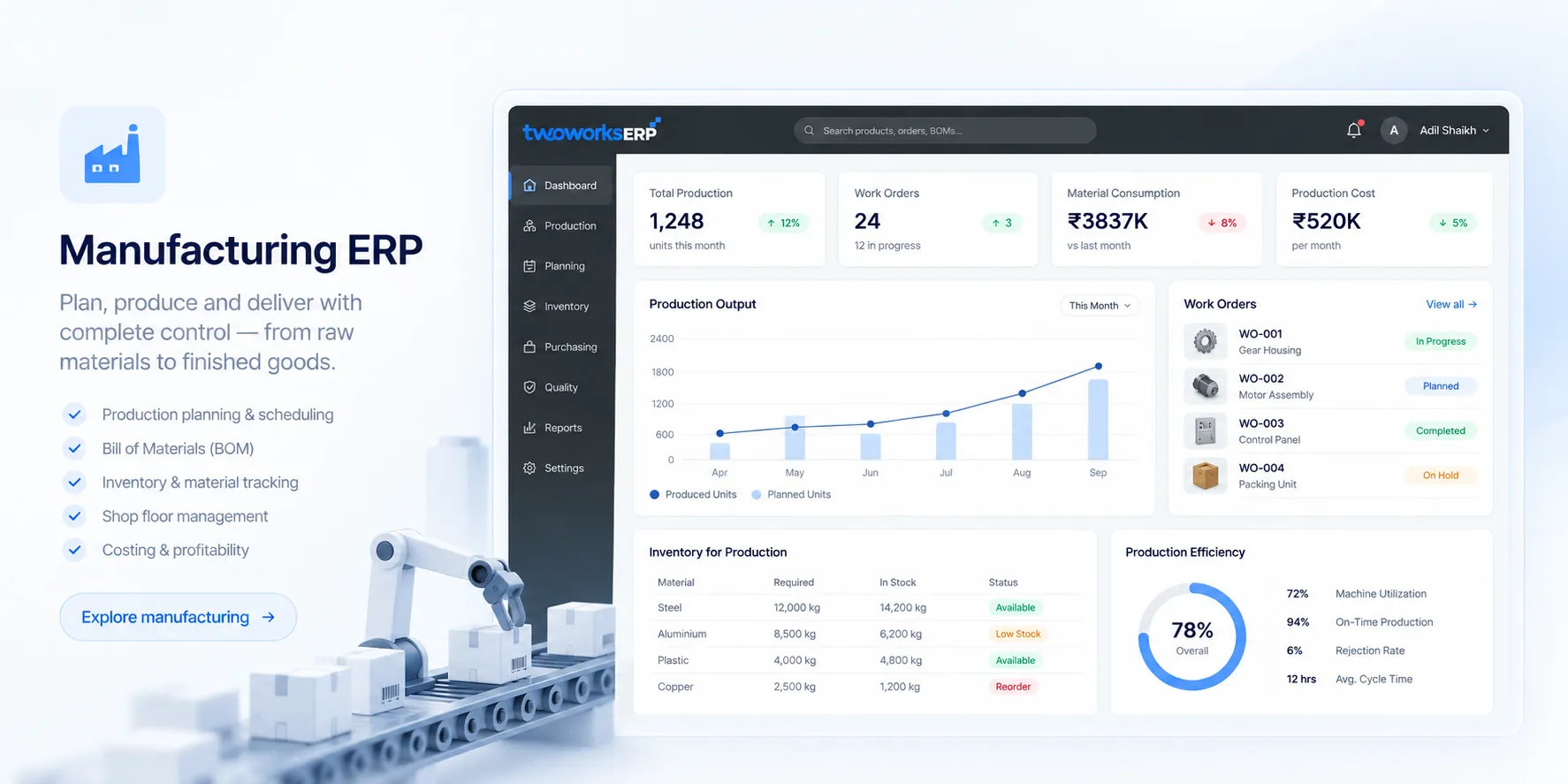
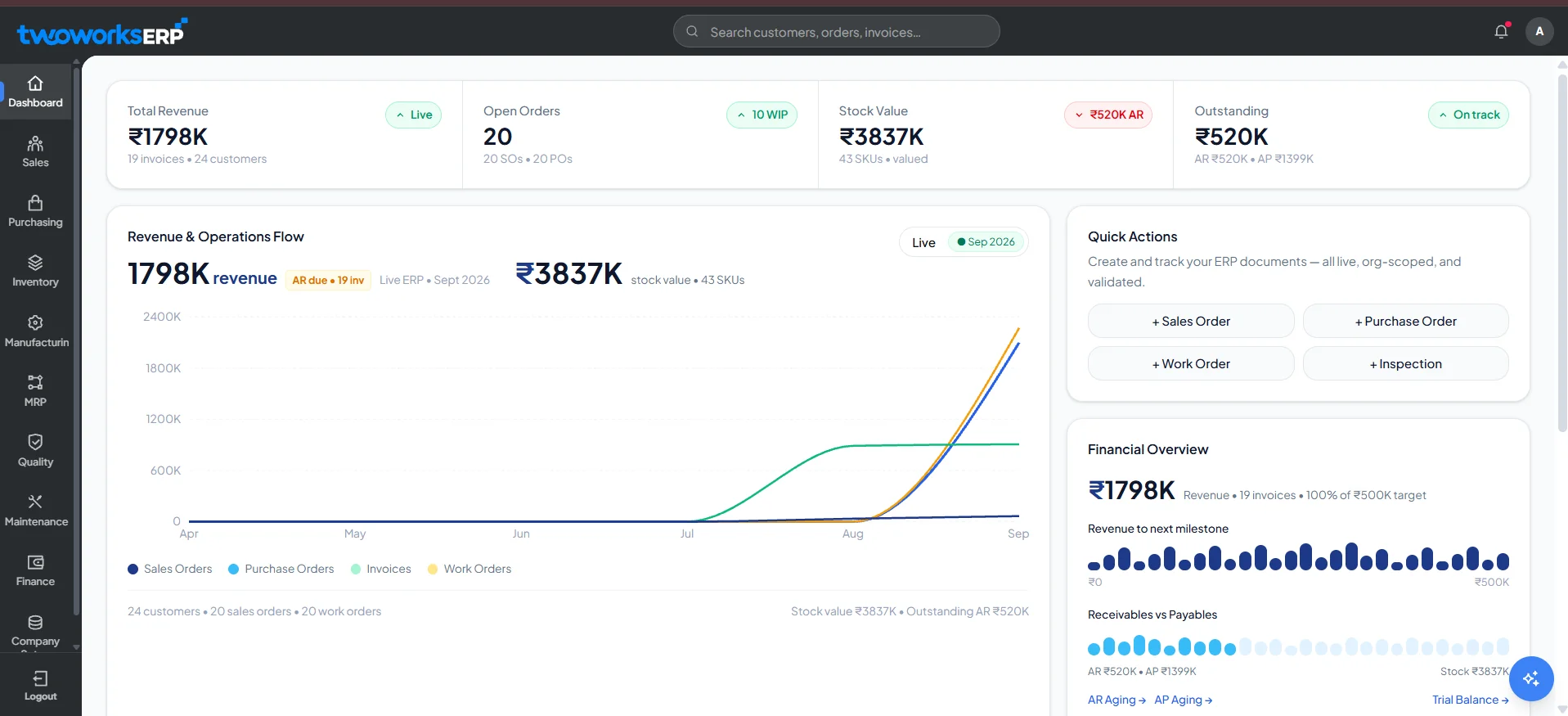
TwoWorks ERP is a cloud-based platform built around nine core modules: Sales & POS, Purchasing, Inventory & Warehouse, Manufacturing, MRP, Quality Management, Maintenance, Finance & Accounting, and Company Management. It supports both cloud/SaaS and on-premise deployment, multi-branch and multi-company setups, and lists Textile & Garments among the 12+ industries it's configured to serve, alongside Manufacturing, Retail & Trade, Construction, Distribution & Logistics, Food & Beverage, Healthcare, and Services & Consulting.
A separate functional overview of the platform, sourced through partner documentation, describes garment-specific capabilities in more detail. That includes buyer order and merchandising management with style, size, and color breakups, cutting room and fabric control with variance analysis, sewing line planning with SMV-based (Standard Minute Value) operator efficiency tracking, and dedicated job-work and subcontracting management. Because this detail comes from a functional overview rather than TwoWorks' own product page, treat the garment-specific claims as the more specialized source and the module list above as the platform-wide baseline.
Pricing: Not publicly disclosed. You'll need to contact the vendor for a quote based on user count and modules.
Best features:
- Multi-level BOM built around styles, sizes, and colors
- Cutting room and fabric control with wastage and variance analysis
- Sewing line management with SMV-based operator efficiency reporting
- Job-work challans for inward and outward material movement, with vendor reconciliation
- Pre-costing vs. actual costing, broken down by buyer order and style
- GST-compliant invoicing and integrated Indian accounting
Pros:
- Garment-specific logic (style, size, color matrices) instead of generic item codes bolted onto a general ERP
- Fabric wastage and variance analysis targets the single biggest cost leak in garment production
- Native job-work tracking fits how small Indian garment units actually operate, with embroidery, washing, and specialized stitching routinely outsourced
- Real-time line-wise WIP visibility helps supervisors catch bottlenecks before they cost a shipment deadline
Cons:
- Pricing isn't public, so you can't budget without a sales call
- The depth of the production modules means factories moving off paper-based systems will need real onboarding time
- Some capabilities (garment-specific detail) come from a functional overview rather than the primary product page, so confirm scope directly with the vendor before signing
Garment manufacturing capabilities:
| Area | Support |
|---|---|
| BOM | Multi-level, style/size/color based |
| Fabric management | Roll, lot, and shade-level tracking with wastage analysis |
| Production | Sewing line planning, SMV tracking, line-wise WIP |
| Job work | Inward/outward challans, vendor rate settlement, wastage tracking |
| Costing | Pre-cost vs. actual, order and style-wise margin |
| Inventory | Style-color-size matrix, multi-warehouse, barcode-enabled |
| Quality | Inline and final inspection, rework and alteration tracking |
| Accounting | GST-compliant invoicing, integrated finance |
Manufacturing type: Garment manufacturing, apparel production, textile manufacturing.
Company size: Small businesses through mid-market.
Industries: Manufacturing, Retail & Trade, Construction, Distribution & Logistics, Food & Beverage, Healthcare, Textile & Garments, Services & Consulting, and other configurable verticals.
AI and automation: Specific AI capabilities aren't publicly disclosed. The production planning modules generate automated alerts for delays, bottlenecks, and inventory shortages, which is workflow automation rather than a named AI feature.
Integrations: Logistics and transportation ERPs for delivery and export visibility, plus payroll and attendance systems for labor cost calculation.
Deployment: Cloud/SaaS and on-premise.
Implementation: The company states that a standard deployment covering core modules typically takes 4 to 8 weeks, including data migration, user training, and go-live support. Actual timelines vary by module count and business complexity.
India support: GST-compliant invoicing, integrated Indian accounting, audit-ready financial records, and job-work compliance workflows built for domestic regulations.
Learn more: Explore the full TwoWorks ERP platform to see current modules and request a walkthrough.
2. LOGIC ERP
Best for: Growing Indian apparel brands that need factory production connected directly to retail, POS, and e-commerce.
LOGIC ERP has been operating in the Indian market for over 33 years. It's one of the few platforms on this list that genuinely bridges manufacturing and omnichannel retail under one roof, which matters if your garment business also runs its own stores or D2C site.
Pricing: Custom, quote-based. Given the platform's scope, expect licensing costs to scale meaningfully with modules and user count.
Best features:
- Configurable multi-level BOMs for garment production
- Attribute system built for size, color, pattern, and design combinations
- Process-department-wise inventory and raw material consumption tracking
- Auto-replenishment and omnichannel order fulfillment
- Power BI-based dashboards and AI-assisted stock alerts
Pros:
- Rare combination of factory-floor production and retail POS in one platform, with no third-party middleware needed
- Deep localization for Indian GST and supply chain rules
- Advanced warehouse management with rack and bin-level control for accurate stock counts
Cons:
- The feature set spans manufacturing, retail, and finance, which is more than a single-unit micro factory typically needs
- Implementation runs longer than plug-and-play SaaS tools because of that scope
- The interface leans more traditional than newer cloud-native platforms
Garment manufacturing capabilities: Configurable single and multi-level BOMs by piece, batch, or lot size. Process-wise, piece-rate, and overhead costing. Job-worker tracking that covers material issue, WIP at vendor sites, and finished-goods receipt with cost reconciliation. Advanced WMS with mobile handheld picking and packing.
Manufacturing type: Garment manufacturing with integrated retail and distribution.
Company size: SMB, mid-market, and enterprise.
Industries: Apparel, footwear, retail, FMCG, distribution.
AI and automation: Power BI-based business intelligence templates and AI-assisted alerts for stock violations and demand forecasting.
Integrations: Major e-commerce platforms, Unicommerce, Increff, digital wallets, and EDC payment machines.
Deployment: Cloud, SaaS, and on-premise.
India support: Automated GST billing, e-way bills, multi-state operations, and Indian payroll integration.
Implementation: Requires a dedicated project team; typically spans several weeks to months depending on how many retail nodes connect to the manufacturing core.
Official website: logicerp.com
3. ERPNext
Best for: Tech-savvy small garment manufacturers who want to avoid per-user licensing fees and are comfortable customizing an open-source system with a local implementation partner.
ERPNext is an open-source ERP built on the Frappe framework. It's not marketed as a fashion-specific ERP, but its flexible item-variant system and strong Indian accounting make it a genuinely popular choice inside Indian textile and garment clusters, usually configured by a local partner to fit garment workflows.
Pricing: Free if self-hosted. Frappe Cloud managed hosting runs roughly $10 to $50 per month depending on usage. Budget separately for implementation: a garment-specific setup through a local partner in India typically runs ₹2,00,000 to ₹4,00,000 (about $2,400 to $4,800).
Best features:
- Item template architecture that handles color, size, and finish variants at scale
- Native job-work and subcontracting workflows tied to Indian tax compliance
- Multi-level BOMs linked to specific garment variants
- Lot, batch, and serial tracking
Pros:
- Zero per-user licensing fees, which means unlimited shop-floor staff can log in without inflating your bill
- Job-work functionality is native and built around Indian compliance, not bolted on
- Large, active implementation partner network across India
Cons:
- Requires real configuration work to function as a garment-specific ERP out of the box
- The interface has a learning curve for shop-floor workers used to simple mobile apps
- No built-in fashion PLM features like tech packs or design-tool syncing
Garment manufacturing capabilities: Item templates for color, finish, and length variants. Nested multi-level BOMs. Lot and batch tracking of fabric inward receipts and consumption against production orders. Native subcontracting workflows that generate delivery notes for job workers and factor processing costs into finished-goods valuation automatically. Textile-sector partners frequently add custom "Lot Master" and "Bale Master" functionality on top of the base system.
Manufacturing type: Manufacturing, textiles, retail, distribution.
Company size: Small business through mid-market.
Industries: Manufacturing, textiles, retail, services, distribution.
AI and automation: No native generative AI publicly verified. Supports extensive workflow automation, scheduled jobs, and custom scripting for alerts and reordering.
Integrations: REST API, WooCommerce, Shopify, Amazon, and standard banking and payment gateways.
Deployment: Cloud, SaaS, on-premise, and private cloud.
India support: Indian accounting standards, multi-state GST, HSN/SAC codes, automated e-invoicing, e-way bill generation, and TDS.
Implementation: A customized garment setup with an experienced partner typically takes 4 to 8 weeks.
Official website: erpnext.com
4. WFX Cloud ERP
Best for: Growing fashion brands and medium-sized manufacturers focused on product development (PLM), production efficiency, and export compliance.
World Fashion Exchange (WFX) is built specifically for apparel and textiles from the ground up, connecting product development, shop-floor production control, and finance in one system.
Pricing: Custom, quote-based. Estimated annual pricing for a platform at this scope typically starts around $15,000 per year and scales up depending on factory size and modules.
Best features:
- Fashion-native PLM and tech pack creation
- Time & Action (TNA) calendars to keep production on schedule
- Real-time hourly production tracking at the line and process level
- Granular cost sheets covering fabric, trims, CMT charges, washing, testing, and freight
Pros:
- Fully focused on apparel supply chain nuances rather than adapted from a generic ERP
- Real-time visibility into production efficiency and material availability
- Combines PLM, ERP, and manufacturing execution instead of requiring three separate tools
Cons:
- Estimated pricing is likely out of reach for micro-factories and early-stage startups
- The end-to-end scope demands dedicated internal project management to adopt properly
- Built with larger, multi-factory operations in mind, which can overcomplicate a single-unit workflow
Garment manufacturing capabilities: PLM for styling, sketches, and multi-level BOMs tied to sizing matrices. Fabric consumption automation with roll and lot-level tracking. Real-time PPC (production planning and control) at line and process level. Job-work tracking through a supplier portal. Cost sheets comparing quoted costs to actual costs order by order.
Manufacturing type: Fashion, apparel, textiles, footwear, accessories.
Company size: SMB, mid-market, and enterprise.
AI and automation: Marketed as AI-powered, with dynamic BI dashboards for reporting and production/procurement insights.
Integrations: Shopify, FastReactPlan (Coats Digital) for capacity planning, SAP Build, Microsoft Dynamics 365.
Deployment: Cloud/SaaS.
India support: Handles GST and local compliance requirements alongside export documentation for international trade.
Implementation: Typically 8 to 12 weeks depending on data migration complexity and training.
Official website: worldfashionexchange.com
5. TallyPrime (with garment add-ons)
Best for: Micro to small garment units in India where job-work tracking and airtight GST compliance matter more than visual production scheduling.
TallyPrime is the default accounting software across Indian small business, and a huge share of small garment manufacturers already run it. It's not a manufacturing execution system. But its job-work registers and GST handling are hard to beat, and third-party garment add-ons extend it into basic BOM and matrix territory.
Pricing: Silver edition (single user): ₹22,500 (about $270) as a lifetime license, plus 18% GST. Gold edition (multi-user): ₹67,500 (about $810) lifetime, plus 18% GST. A monthly subscription option starts at ₹750/month. Garment-specific add-ons from certified partners cost extra and vary by provider.
Best features:
- Job-work inward and outward registers built for Indian compliance, including ITC-04 and GSTR-4 reporting
- Cost center analysis and profitability tracking
- Godown (warehouse) and batch-wise inventory
- Full offline capability
Pros:
- Extremely low total cost of ownership, especially with the lifetime license option
- Every Indian accountant already knows how to use it, so staffing is easy
- Job-work compliance, reverse charge handling, and ITC tracking are native and reliable
- Works completely offline, so a connectivity outage never stops billing or stock entries
Cons:
- Not a manufacturing execution system: no visual production scheduling or machine-level tracking
- Size, color, and style matrix management requires a certified garment add-on, not native functionality
- Keyboard-driven interface that looks dated next to modern cloud ERPs
Garment manufacturing capabilities: Basic BOM natively; size, color, and style matrix requires a Tally-certified garment add-on. Manufacturing journal entries move stock from raw material to WIP to finished goods, but without routing or line balancing. Job-work tracking is a genuine standout: material issued, returns, process wastage, and GST reporting all handled natively.
Manufacturing type: General manufacturing, textiles, distribution, services.
Company size: Micro business through SMB.
AI and automation: No generative AI publicly verified. Built-in automation for GST filing and e-invoicing accuracy.
Deployment: On-premise and hosted cloud.
India support: The benchmark for Indian compliance: multi-state GST, HSN/SAC codes, TDS, automated GSTR return prep, and e-invoicing.
Implementation: Core software installs instantly. Custom garment modules and data migration typically take 1 to 4 weeks depending on the partner.
Official website: tallysolutions.com
6. Katana Cloud Manufacturing
Best for: Modern direct-to-consumer apparel brands and small make-to-order workshops that want a highly visual, e-commerce-connected production system.
Katana wins on interface. If your team is more comfortable dragging and dropping than reading a spreadsheet, this is the most approachable system on this list.
Pricing: Core plan starts at $359/month (billed annually). Shop Floor Control, Barcoding, and Traceability are separate add-ons, each running $149 to $249/month. A fully configured setup typically lands between $500 and $800/month.
Best features:
- Real-time visual master planning that reallocates materials based on order priority
- Variant BOMs for size and color combinations
- Dedicated Shop Floor app for operator task management
- Native, deep sync with Shopify, Xero, and QuickBooks Online
Pros:
- Modern, intuitive interface that needs minimal training
- Handles both make-to-order and make-to-stock workflows
- Variant BOMs support apparel size and color matrices without workarounds
- Best-in-class e-commerce integration for DTC brands
Cons:
- No native Indian GST, e-invoicing, or job-work challan documentation; you'll need to rely on third-party accounting for that
- Essential shop-floor features are paid add-ons, which pushes the real monthly cost well above the base price
- Lacks textile-specific features like fabric roll tracking or shrinkage calculation
Garment manufacturing capabilities: Variant BOMs for color and size specs under a parent product. Real-time raw material visibility with automatic reorder alerts. Drag-and-drop production scheduling with auto-allocated materials. Contract manufacturing support for tracking components sent to outsourced vendors and finished goods received back.
Manufacturing type: Apparel, custom manufacturing, make-to-order and make-to-stock.
Company size: Small business and SMB.
AI and automation: No generative AI publicly verified. Relies on automated workflow routing and real-time stock reallocation logic.
Integrations: Shopify, WooCommerce, Xero, QuickBooks Online.
Deployment: Cloud/SaaS.
India support: Limited. GST, e-invoicing, and e-way bills must be handled externally through integrated accounting software.
Implementation: DIY-friendly; most businesses can configure and go live within days to weeks using the platform's documentation.
Official website: katanamrp.com
7. ApparelMagic
Best for: Small fashion brands prioritizing product development (PLM) and B2B wholesale distribution over deep shop-floor manufacturing execution.
ApparelMagic aligns design, costing, sales, and distribution around fashion industry logic specifically, which shows in features like tech pack management and B2B line sheets that generic ERPs don't offer.
Pricing: Professional plan: $337/month. Enterprise plan: $655/month. Ultimate plan: custom pricing. Rates are based on annual billing and limit users, warehouses, and integrations per tier.
Best features:
- Advanced PLM with tech packs, sketches, and style tracking
- Built-in B2B eCommerce portal (line sheets) for wholesale orders
- Allocation and replenishment forecasting
- Native multi-currency accounting
Pros:
- Built purely around fashion industry logic instead of adapted from generic ERP software
- Strong B2B wholesale tools, including digital line sheets for buyers
- Unifies PLM and ERP, cutting duplicate data entry between design and production teams
- Strong live onboarding and orientation training from the vendor
Cons:
- No native Indian GST support or documented job-work challan handling
- Less focus on deep, machine-level shop-floor execution compared to production-first platforms
- The $337/month starting price limits access for very small startup factories on tight cash flow
Garment manufacturing capabilities: PLM tracks styles, sketches, and multi-level BOMs within a size and color matrix. Real-time raw material visibility tied to production schedules. Job-work support through purchase orders generated for cut-make-trim (CMT) services based on approved BOMs. Landed cost and manufacturing cost tracking with style-level profitability.
Manufacturing type: Fashion, apparel, footwear, accessories.
Company size: Small business and SMB.
AI and automation: ApparelMagic Intelligence includes an AI image-generation tool that lets design teams create sketches and photographs from text prompts. That's the one clearly named AI feature across this whole list.
Integrations: Shopify, Amazon, BigCommerce, JOOR, NuORDER, QuickBooks Online, ShipStation.
Deployment: Cloud/SaaS.
India support: Not publicly verified. Indian businesses would need a separate accounting integration for statutory compliance.
Implementation: Standard plans include 1-on-1 onboarding and live orientation training.
Official website: apparelmagic.com
8. MRPeasy
Best for: Small garment units that need fast, no-frills production scheduling and are willing to configure variants manually rather than use a native fashion matrix.
MRPeasy is a lightweight, cloud-based MRP system built for manufacturers with 10 to 200 employees. It's the fastest platform on this list to deploy, and the cheapest per user among the modern cloud options.
Pricing: Starter: $49/user/month. Professional: $69/user/month. Enterprise: $99/user/month. Unlimited: $149/user/month.
Best features:
- Fast MRP calculations that drive purchasing decisions automatically
- Visual production scheduling and machine routing
- Internet-kiosk interface for shop-floor time and material logging
- Parameterized BOMs
Pros:
- Highly affordable for small teams with minimal upfront investment
- Fast cloud deployment compared to traditional ERPs
- Strong capacity planning that prevents machines (or lines) from getting double-booked
- Simple shop-floor kiosk interface needs almost no training
Cons:
- Not apparel-first; size and color matrices need parameter workarounds instead of native support
- No out-of-the-box Indian GST or e-way bill generation
- Multi-site tracking is locked behind the Enterprise tier
Garment manufacturing capabilities: Parameterized BOMs configure generic items into specific sizes or colors, with more setup effort than a native fashion PLM. MRP engine calculates exact fabric purchase quantities and timing based on supplier lead times. Dynamic production schedules with automatic work order generation. Subcontracting support by assigning specific operations (like washing) to external vendors with automatic purchase orders. Quality management, including inspection workflows, is available from the Professional tier up.
Manufacturing type: Discrete manufacturing, electronics, textiles, general assembly.
Company size: Small business (10 to 200 employees).
AI and automation: No generative AI publicly verified. Highly automated MRP calculation, capacity planning, and reorder forecasting algorithms.
Integrations: QuickBooks, Xero, Shopify, WooCommerce, Zapier.
Deployment: Cloud/SaaS.
India support: Limited. No native GST compliance; requires integration with tools like Zoho Books or QuickBooks India.
Implementation: Highly DIY-friendly with strong documentation and video guides; most factories go live within days to weeks.
Official website: mrpeasy.com
9. SAP Business One
Best for: Established mid-to-large garment SMEs that need enterprise-grade financial control and are prepared to invest in customization.
SAP Business One is a generic SME ERP, not a fashion-first platform. But it's widely adapted for garment manufacturing through specialized add-ons like FashionNx, provided by regional implementation partners.
Pricing: Perpetual license per user plus an annual support contract. A 10-user setup, including implementation and customization, typically runs $35,000 to $75,000.
Best features:
- Uncompromising financial and general ledger control
- Multi-branch and multi-warehouse accounting
- Extensive batch, lot, and serial tracking
- Advanced MRP and demand forecasting
Pros:
- Rock-solid reliability, security, and audit-readiness for growing operations
- Flawless, continuously updated Indian tax compliance (GST, TDS, e-invoicing)
- Large ecosystem of local Indian implementation partners
- Eliminates data silos between finance and production across the whole company
Cons:
- High total cost of ownership makes it unviable for small or startup manufacturers
- Native garment workflows require costly add-ons, not built-in functionality
- Steep learning curve for shop-floor workers compared to mobile-first apps
Garment manufacturing capabilities: Standard BOMs natively; color and size variation at scale requires an add-on like FashionNx. Batch and lot traceability tracks procurement dates and bin storage for FIFO fabric usage. Job-work tracking is supported through Indian implementation partners who configure the system to local job-work tax rules and challan generation. Real-time cost and price valuation across goods movement.
Manufacturing type: Apparel (via add-on), FMCG, engineering, automotive, pharmaceuticals.
Company size: Mid-market, enterprise, and large SME.
AI and automation: Interactive dashboards, real-time KPI monitoring, and predictive analytics for executive decision-making.
Deployment: On-premise, private cloud, and cloud.
India support: Thoroughly localized: GST, TDS, e-way bills, and complex multi-branch accounting.
Implementation: Requires a certified SAP Partner; structured, phase-wise rollout typically taking several months.
Official website: sap.com
10. Acumatica
Best for: Scaling garment units that want cloud flexibility and specifically want to avoid per-user licensing penalties as their shop-floor headcount grows.
Acumatica's resource-based pricing model, rather than per-user licensing, is the reason it makes this list. If you're planning to add 20 more shop-floor logins next year, that pricing structure matters.
Pricing: Custom, generally starting around $1,000/month. Pricing is based on computing resources and transaction volume rather than user count, which means unlimited users can technically access the system without extra license fees.
Best features:
- Native Matrix Items for apparel variant management
- Embedded BI with customizable dashboards
- Manufacturing Data Collection for mobile barcoding
- Rough-cut capacity planning (RCCP) and master production scheduling (MPS)
Pros:
- Unlimited users can access the system, so factory staff, supervisors, and clerks don't inflate license costs
- Strong core manufacturing, routing, and MRP functionality
- Matrix items natively handle apparel size and color combinations without third-party add-ons
- Open API architecture makes integration with modern software stacks straightforward
Cons:
- The roughly $1,000/month starting price is a real barrier for micro-businesses
- Requires localization work or a local partner to handle Indian GST and job-work rules smoothly
- Implementation requires a specialized consulting partner, adding to setup costs
Garment manufacturing capabilities: Matrix items manage pricing and availability across style, size, and color families, simplifying BOM creation. Lot tracking with specific attributes and unit-of-measure conversions for material movement. Native outside-processing support routes materials to external vendors and tracks related processing costs. Loss and yield reporting combined with lot tracking supports quality and buyer compliance standards.
Manufacturing type: Manufacturing, apparel, chemicals, distribution.
Company size: SMB and mid-market.
AI and automation: The 2026 R1 release introduced AI features that surface operational anomalies and support shop-floor decision-making, described by the vendor as practical rather than roadmap-only.
Integrations: Xero, QuickBooks, CAD software, PLM tools, and various e-commerce platforms via open API.
Deployment: Cloud/SaaS.
India support: Requires configuration or a local partner integration to handle native Indian GST and job-work regulations, unlike hyper-localized systems like TallyPrime.
Implementation: Handled exclusively through certified partners; typically spans several months due to configuration depth.
Official website: acumatica.com
Comparison table
| ERP | Best for | Starting price | Garment BOM | Job work | India support |
|---|---|---|---|---|---|
| TwoWorks ERP | End-to-end garment production and floor control | Custom pricing | Style/size/color matrix | Native, with challans | Strong |
| LOGIC ERP | Garment manufacturing + omnichannel retail | Custom pricing | Multi-level, matrix-based | Native | Strong |
| ERPNext | Customizable, budget-friendly manufacturing | Free (self-host) / custom | Multi-level, needs config | Native | Strong |
| WFX Cloud ERP | Fashion PLM + production for growing brands | ~$15,000/year (estimated) | PLM-driven, matrix-based | Native, via supplier portal | Moderate |
| TallyPrime + add-ons | Accounting-first units with heavy job work | ₹22,500 lifetime | Needs certified add-on | Native, best-in-class | Strong |
| Katana Cloud Manufacturing | DTC brands, make-to-order units | $359/month + add-ons | Variant BOM, native | Supported | Limited |
| ApparelMagic | Fashion PLM + B2B wholesale | $337/month | PLM-driven, matrix-based | Via purchase orders | Not verified |
| MRPeasy | Lightweight MRP for small units | $49/user/month | Parameterized, needs config | Supported | Limited |
| SAP Business One | Enterprise financial control | ~$35,000 for 10 users | Needs add-on (FashionNx) | Via implementation partner | Strong |
| Acumatica | Scaling units, resource-based pricing | ~$1,000/month | Native matrix items | Native | Moderate |
Which ERP features actually matter for a small garment manufacturer?
Not every feature on a vendor's spec sheet moves the needle. Here's what does, and why.
Garment BOM. A BOM that only lists "fabric" isn't a garment BOM. A real one breaks down fabric, trims, buttons, zippers, labels, thread, elastic, and packaging per style, so you know exactly what a style needs before you cut a single roll.
Size and color variants. If your system treats every size-color combination as an unrelated SKU, you'll spend hours reconciling stock manually. A true variant matrix keeps them tied to one style and one BOM.
Fabric consumption and wastage tracking. Fabric is usually the single biggest cost in garment production. A system that tracks planned vs. actual consumption catches wastage before it eats your margin, not after.
Job work. If you send work to subcontractors, and most small Indian garment units do, this isn't optional. You need to know what fabric left your factory, what came back, and what it cost, or you're flying blind on a huge chunk of your production.
WIP visibility. Knowing that 200 pieces are "somewhere in production" isn't useful. Knowing that 200 pieces are at the stitching stage, on Line 3, two days behind schedule, is.
Style-wise costing. A factory-wide average cost tells you almost nothing about which styles are actually profitable. You need cost and margin broken down per style, per buyer order.
GST and compliance. For Indian manufacturers, this isn't a nice-to-have. Job-work-specific GST rules (like ITC-04 reporting) are complicated enough that a system without native support forces you into manual reconciliation every filing period.
How much does garment manufacturing ERP cost?
Pricing across this list falls into four different models, and that matters more than the raw number.
Per-user, per-month. MRPeasy ($49 to $149/user/month) and Katana ($359/month base plus add-ons) charge this way. Costs scale directly with headcount, which is predictable but can get expensive fast if a lot of shop-floor staff need logins.
Flat monthly or annual fee. ApparelMagic ($337 to $655/month) and estimated WFX pricing (~$15,000/year) charge a tiered flat fee, usually with limits on users, warehouses, or integrations per tier.
Lifetime license. TallyPrime is the outlier here. ₹22,500 for a single-user lifetime license is a fundamentally different cost structure than a monthly SaaS subscription, and it's a big reason it remains so popular among cost-conscious small manufacturers.
Resource or consumption-based. Acumatica prices by computing resources and transaction volume, not user count, which is why unlimited users can log in without inflating the bill.
Custom, quote-only. TwoWorks ERP, LOGIC ERP, SAP Business One, and Acumatica's exact tier all require a sales conversation before you get a number.
Whatever the sticker price says, always ask about three things separately: implementation cost, training cost, and the cost of any required add-ons (like a garment matrix module for TallyPrime or SAP Business One). The base subscription is rarely the full number.
ERP for small garment manufacturers vs. enterprise apparel ERP
Enterprise apparel ERP (think SAP Business One at full scale, or Infor CloudSuite Fashion, which isn't in this list because it's out of range for small manufacturers) is built for multi-factory operations with dedicated IT teams.
A small garment manufacturer doesn't need that. Here's what actually differs:
Implementation timeline. Small-business-fit systems (TallyPrime, MRPeasy, Katana) go live in days to weeks. Enterprise systems (SAP Business One, WFX) take months and require certified implementation partners.
Customization requirements. ERPNext and SAP Business One both need configuration work to handle garment specifics, but the scale is different. A small manufacturer needs one partner for a few weeks. An enterprise deployment needs an ongoing relationship with a systems integrator.
IT overhead. Cloud-native, small-business tools don't require an internal IT team. On-premise enterprise deployments often do.
Cost tolerance. A small manufacturer evaluating a $35,000 SAP Business One setup, or a $15,000/year WFX subscription, needs to weigh that against actual revenue and margin, not against what a 500-person factory can absorb.
The right question isn't "which ERP has the most features." It's "which ERP fits my current order volume, staff count, and budget, with room to grow for the next two to three years without a full replatform."
ERP for garment manufacturers in India
If you're manufacturing in India, compliance isn't a side feature. It's core to whether the system is usable at all.
GST invoicing and e-invoicing. Every sale and purchase needs to generate compliant tax documentation automatically. TallyPrime, ERPNext, LOGIC ERP, TwoWorks ERP, and SAP Business One all handle this natively, based on this research.
E-way bills. Required for moving goods (including fabric between your factory and job workers) above certain value thresholds. Native support matters if you're moving fabric in and out of subcontractor sites regularly.
Job work compliance. This is where most non-Indian ERPs fall short. TallyPrime's job-work registers, including ITC-04 and GSTR-4 reporting, are purpose-built for this. TwoWorks ERP, LOGIC ERP, and ERPNext also describe native job-work workflows tied to compliance. Katana, MRPeasy, and ApparelMagic don't, based on this research, which means you'd need a separate accounting layer to stay compliant.
Multi-state operations. If you're sourcing fabric from one state and manufacturing in another, or shipping to buyers across state lines, GST becomes more complex. LOGIC ERP, ERPNext, SAP Business One, and TwoWorks ERP explicitly support multi-state GST handling.
Export documentation. Relevant if you're manufacturing for overseas buyers. WFX Cloud ERP specifically calls out export documentation support alongside GST handling.
If your factory does meaningful job work, and most small Indian garment units do, weight this category heavily. A system with excellent production planning but weak job-work GST support will create real accounting headaches every single filing cycle.
How to choose the right ERP for your garment business
Work through these questions before you talk to a single vendor.
1. How many employees and shop-floor workers do you have? Under 20 people, look hard at TallyPrime with add-ons or MRPeasy. Over 50, LOGIC ERP or TwoWorks ERP start making more sense.
2. How many styles and SKUs are you managing? A handful of styles with simple size runs doesn't need PLM-heavy software like ApparelMagic or WFX. Dozens of styles with complex variant grids do.
3. Are you make-to-order, make-to-stock, or both? Katana handles both well. Job-work-heavy manufacturers should prioritize systems with native subcontracting support over pure MTS or MTO logic.
4. How dependent are you on job work? If embroidery, printing, washing, or specialized stitching regularly leaves your factory, put job-work tracking at the top of your checklist. This single factor eliminates several platforms on this list immediately.
5. How complex is your fabric inventory? Multiple fabric types, shades, and lots need roll and lot-level tracking (TwoWorks ERP, WFX, ERPNext with customization). Simple, single-fabric operations can get away with less.
6. What's your GST and compliance requirement? If you're filing GST returns monthly and doing job work, weight TallyPrime, ERPNext, LOGIC ERP, and TwoWorks ERP higher. If you're outside India, this factor drops away entirely.
7. Do you need export documentation? If yes, WFX and SAP Business One have more documented support here than DTC-focused tools like Katana.
8. What's your realistic implementation budget? Be honest about whether you can absorb a $35,000 SAP Business One rollout or a $15,000/year WFX subscription, versus a ₹22,500 TallyPrime license plus a smaller add-on cost.
9. Can your shop floor actually use it? A system with the deepest feature set is worthless if cutting masters and line supervisors won't touch it. Weight ease of use heavily if you're moving off paper for the first time.
10. Does it scale for the next 2 to 3 years? Don't just solve for today's order volume. Ask what happens to cost and complexity if you double your production in 24 months.
Before you sign anything, ask every vendor these questions directly: Can it create style-wise BOMs with fabric, trims, and packaging? Can it track material issued to and received from job workers? Can it compare planned vs. actual fabric consumption? Can it calculate production cost by style, not just factory-wide? Their answers, not their marketing page, will tell you what you're actually buying.
For a closer look at procurement and inventory workflows specifically, see TwoWorks' procurement and inventory tools.
Pricing, features, and capabilities reflect information available as of September 2026 and may change. Confirm current pricing and functionality directly with each vendor before making a purchasing decision.